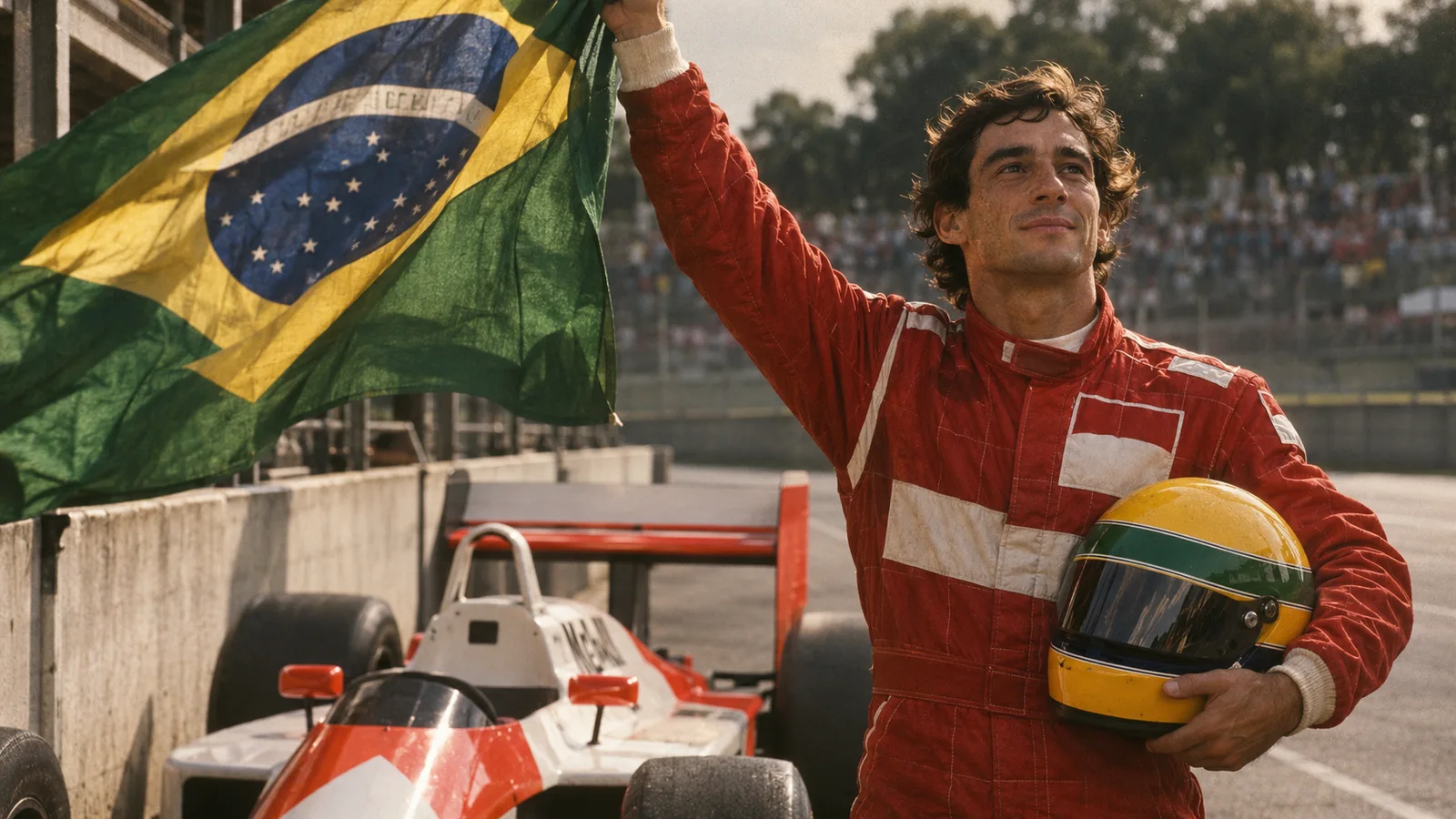
The years from 1988 to 1991 brought three championships. Inside that extraordinary record were a dominant car, a shifting partnership, a painful loss, and a title fight that demanded a different kind of strength.
In this chapter 8 sections ↓
Woking builds a possibility
In 1988, McLaren paired Senna and Prost with Honda power in the MP4/4. The low car was designed around the demands of the final turbo season: restricted fuel, limited boost and the need to turn the engine’s efficiency into speed over a race distance. The driver was the most visible part of a much larger concentration of expertise.
The result was fifteen wins in sixteen races. That dominance did not make the drivers’ work irrelevant; it concentrated their most immediate competition inside their own team. For Senna, the opportunity was exceptional. For Prost, it meant defending his place against a younger teammate who could use much of the same machinery to expose every small difference between them.
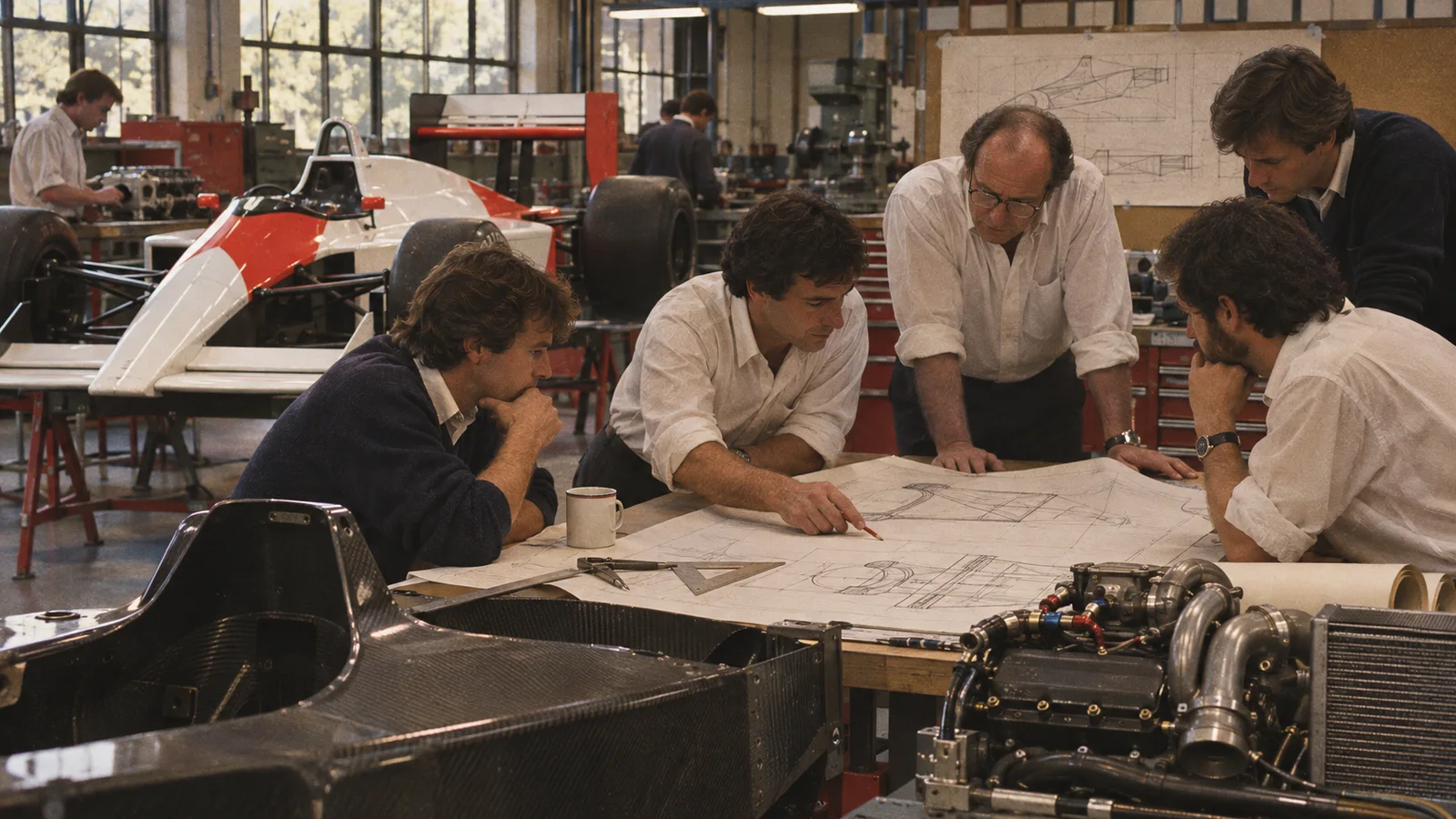
An imagined McLaren engineering environment. No drafting sheet, meeting or specific engineer is presented as documentary evidence.
Monaco’s two truths
The official qualifying times at Monaco were 1:23.998 for Senna and 1:25.425 for Prost. The difference, 1.427 seconds, is remarkable because the comparison is with another great driver in the other McLaren. The lap remains one of the clearest measured expressions of Senna’s single-lap ability.
On Sunday, he crashed at Portier while leading. Prost won. The weekend cannot honestly be reduced either to transcendence or to failure. It contained both: speed that enlarged the imagination of what a driver could do, and a mistake that showed the limits of turning that speed into a completed Grand Prix.
FOLLOW THIS STORYExplore the qualifying lap and the Sunday that followedSuzuka, 1988: the start that went wrong
At the race where he could secure his first championship, Senna stalled from pole. Suzuka’s downhill grid helped him get moving again, but he had fallen deep into the field. The title opportunity now required a recovery rather than a clean escape from the front.
He caught and passed Prost, taking the lead on lap twenty-seven in McLaren’s account, and won the race. Eight victories to Prost’s seven gave him the championship under the scoring system that counted each driver’s best eleven results. The first title was both the reward for a season of exceptional performances and a result produced inside a particular set of rules.
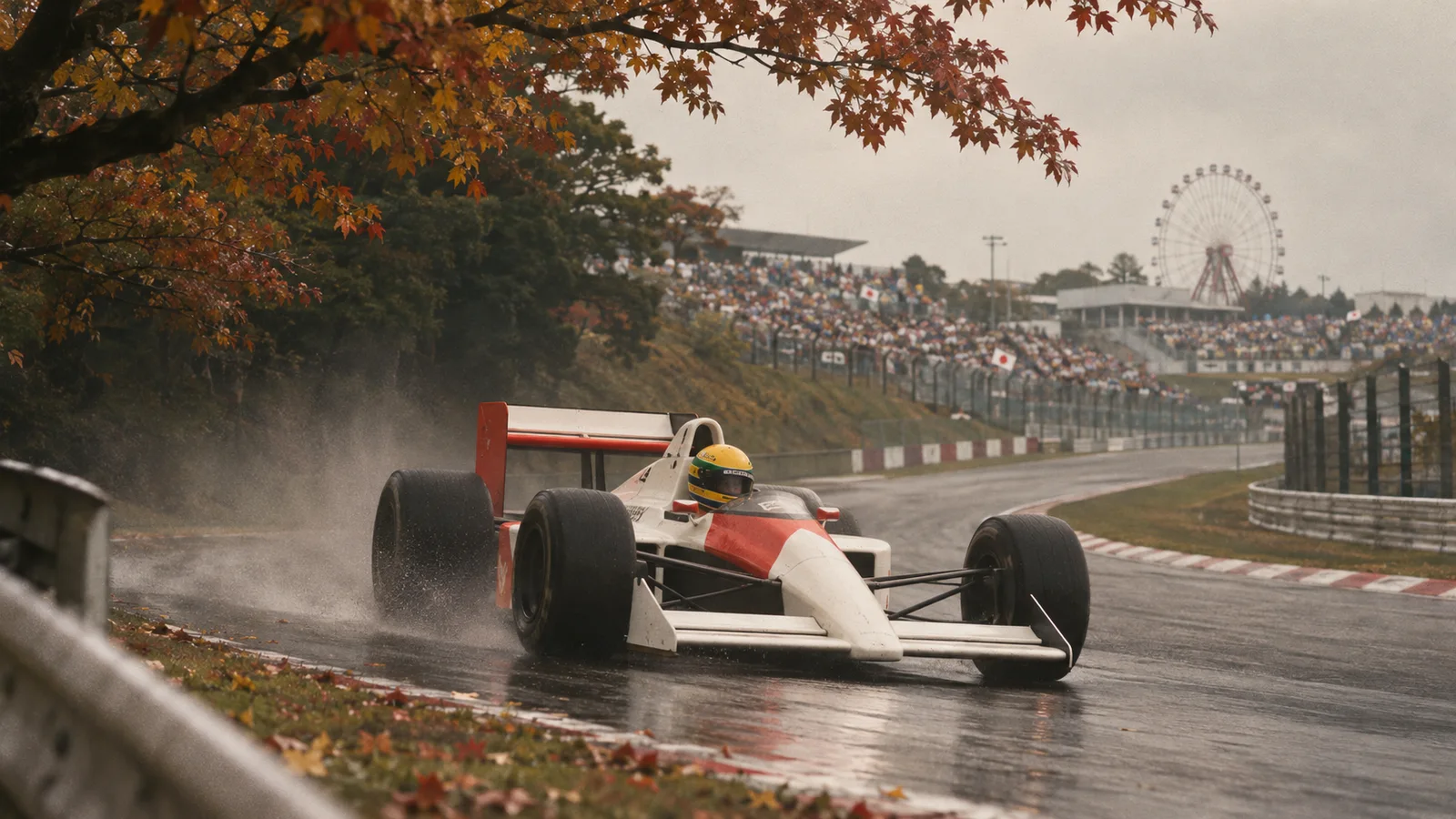
An artistic interpretation of a 1988 McLaren at Suzuka. Not a recorded championship lap.
The partnership fractures
Winning did not settle the question of whose team McLaren was. Ron Dennis described a management problem involving promises of equal equipment, rival confidences and disagreements that reached beyond the garage. In 1989, the dispute over a non-aggression agreement at the restarted San Marino race became another point of rupture.
At Suzuka, Senna attempted to pass Prost at the chicane and the two cars collided. Prost stopped. Senna rejoined, had his damaged front wing replaced and crossed the line first, only to be disqualified for the way he had returned to the circuit. The official outcome made Prost champion. It also left Senna with a grievance that would shape the next season’s ending.
A second title with an unresolved cost
Prost moved to Ferrari for 1990. At Suzuka, another title could be decided between them. Senna took pole but objected to starting on the dirtier side of the track. Prost made the better start; their cars collided at the first corner, and neither continued. Senna was champion.
A year later he acknowledged that he had acted deliberately. His sense of injustice over 1989 and his anger about the grid provide context for the decision; they do not make the danger to another driver acceptable. The championship remains in the record. So does the action by which the final challenge was ended. Admiration has to be able to hold both.
FOLLOW THIS STORYRead the rivalry through both drivers’ perspectives1991: the work begins again
Gerhard Berger was now his McLaren teammate, and Honda had developed a V12 for the MP4/6. Senna won the opening four races. The new engine was powerful but heavier and more demanding of fuel than the previous V10, while the Williams-Renault challenge strengthened as its reliability improved.
The season was therefore not simply a procession toward a third title. McLaren and Honda had to keep developing. Fuel problems cost Senna results; Mansell’s Williams grew increasingly formidable. The championship depended on the advantage built early and on recovering opportunities when the balance of performance moved away from him.
The finish Brazil had waited for
The opening run included his first victory at Interlagos. As the gearbox deteriorated, he chose sixth as the reliable gear and brought the car home ahead of Riccardo Patrese. The winning margin was 2.991 seconds. The physical strain visible after the finish became inseparable from the meaning of finally winning at home.
Here the machinery was not an abstract explanation of speed. It was a problem he had to solve while the race continued. The most famous version says the car was simply stuck in sixth; McLaren’s account is more precise about his choice as gears became unreliable. That detail gives the driver more agency, not less.
FOLLOW THIS STORYFollow the final laps at InterlagosThree titles, and no still point
He secured the 1991 championship at Suzuka. By the end of the season he had achieved the objective that once lay beyond the karting paddock: three Formula One world titles. But the work had not delivered a permanent condition of being the best. It had delivered a result in a sport whose machinery and opposition would keep changing.
Williams was already pointing toward the next technical benchmark. Senna would enter 1992 carrying the status of champion and the knowledge that status alone could not keep him at the front. The next two seasons would ask how much he could find when the best car was elsewhere.
THE RECORD BEHIND THE STORY
Sources & perspective
References are connected to the passages above. Recollections retain the perspective of their speakers; technical explanations and editorial interpretation do not imply access to private thoughts. All scene imagery is AI-generated.
01 · Honda · machine archiveMcLaren MP4/4 ↗Purpose-built 1988 chassis, Honda engine and fuel restrictions. Technical context from the engine partner.02 · McLaren · heritageAyrton Senna ↗Six McLaren seasons, championships and the Ford-powered MP4/8.03 · Formula 1 · official results1988 Monaco Grand Prix — qualifying ↗Senna 1:23.998; Prost 1:25.425. The difference is calculated from these times.04 · McLaren · team archiveSenna’s moments of Monaco magic ↗His six Monaco wins and the loss in 1988. A former employer’s perspective.05 · McLaren · team archiveTen defining Senna moments at McLaren ↗Suzuka 1988, championship moments and the distinction between a race win and an official classification.06 · McLaren · team history1–2 at San Marino ↗The disputed non-aggression agreement at the restarted 1989 race.07 · Formula 1 · 22 October 2019Prost vs Senna: Suzuka ’89 ↗Collision, rejoining the circuit, disqualification and the title decision.08 · David Tremayne · Formula 1 · April 2024Why Suzuka is so special: a reporter remembers ↗Eyewitness recollections of Senna’s response to the 1990 collision and his subsequent 1991 admission.09 · Alain Prost interviewed by Motor Sport · October 1998Ayrton Senna by Alain Prost ↗Prost’s own account of danger, rivalry and their later conversations; presented as his perspective.10 · McLaren · car archiveMcLaren MP4/6 ↗V12 development, four opening wins, fuel difficulties and the Williams challenge. Participant history.11 · McLarenLegendary Laps: Brazil ’91 ↗Explains the gearbox’s tendency to jump out of gear and his choice to remain in sixth.12 · Formula 1 · official results1991 Brazilian Grand Prix: race result ↗71 laps and the final 2.991-second margin over Patrese.13 · Formula 1 · 2 May 2014Vital statistics: Ayrton Senna ↗Historical totals. Any all-time rankings in this 2014 article are dated and are not repeated as current rankings.Full bibliography & image disclosure ↗