The karting years gave Ayrton his first serious rivals and his first experience of travelling to Europe for a title. They also left him with a championship he never won.
In this chapter 6 sections ↓
Interlagos: the first real opposition
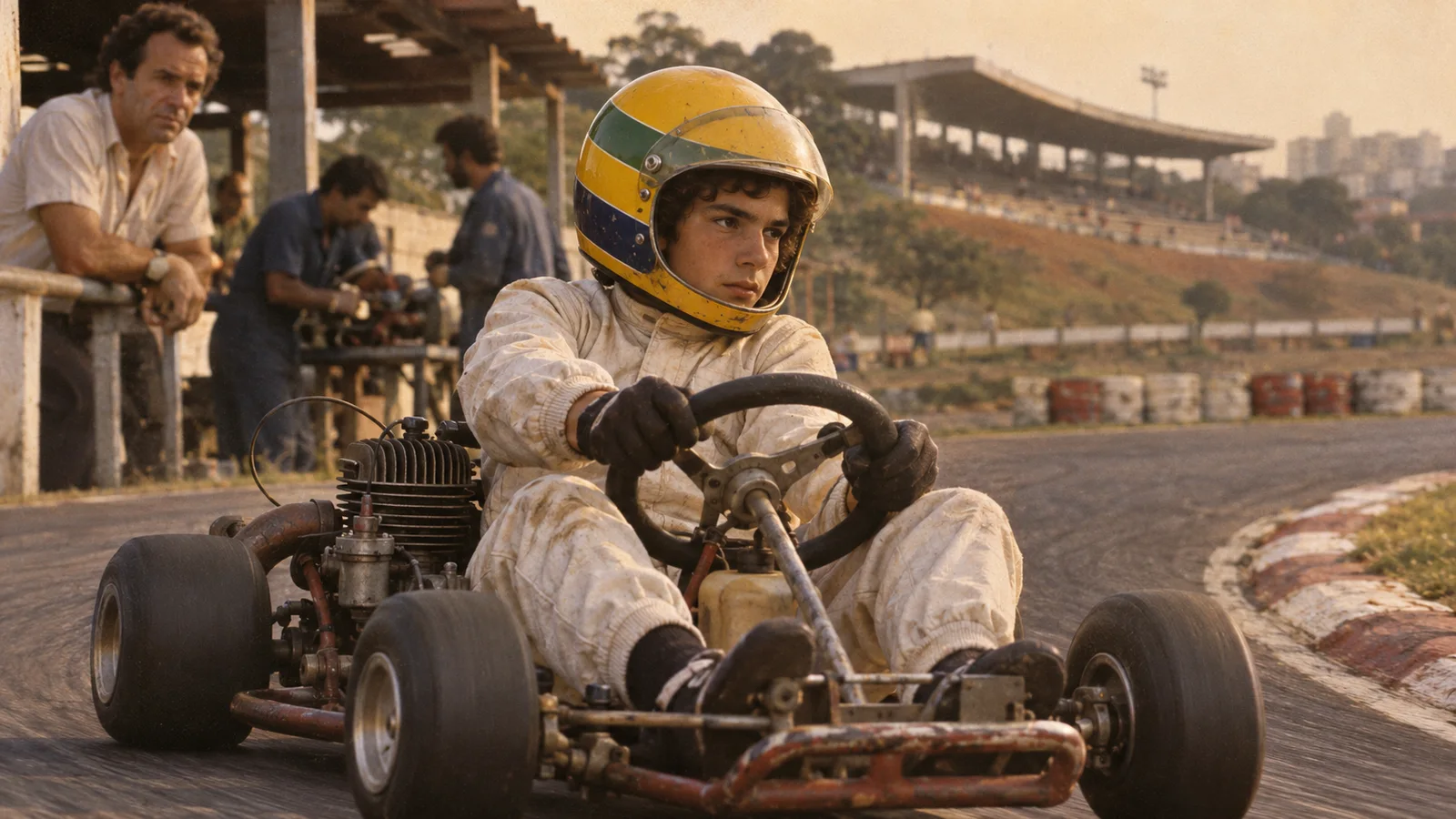
At thirteen, Senna could enter organised kart competition. Formula One’s career history records that he won his debut near the Interlagos circuit. The local successes that followed gave his family a reason to keep investing. A South American title in 1977 made the next question larger: could he compete with the best drivers beyond Brazil?
The difference between a home-built pastime and a championship campaign is repetition under pressure. The engine must work when everyone else’s does. The driver must produce a lap after a disappointing heat, or pass someone who recognises the same opportunity. Winning locally opened the door; it did not remove the need to learn.
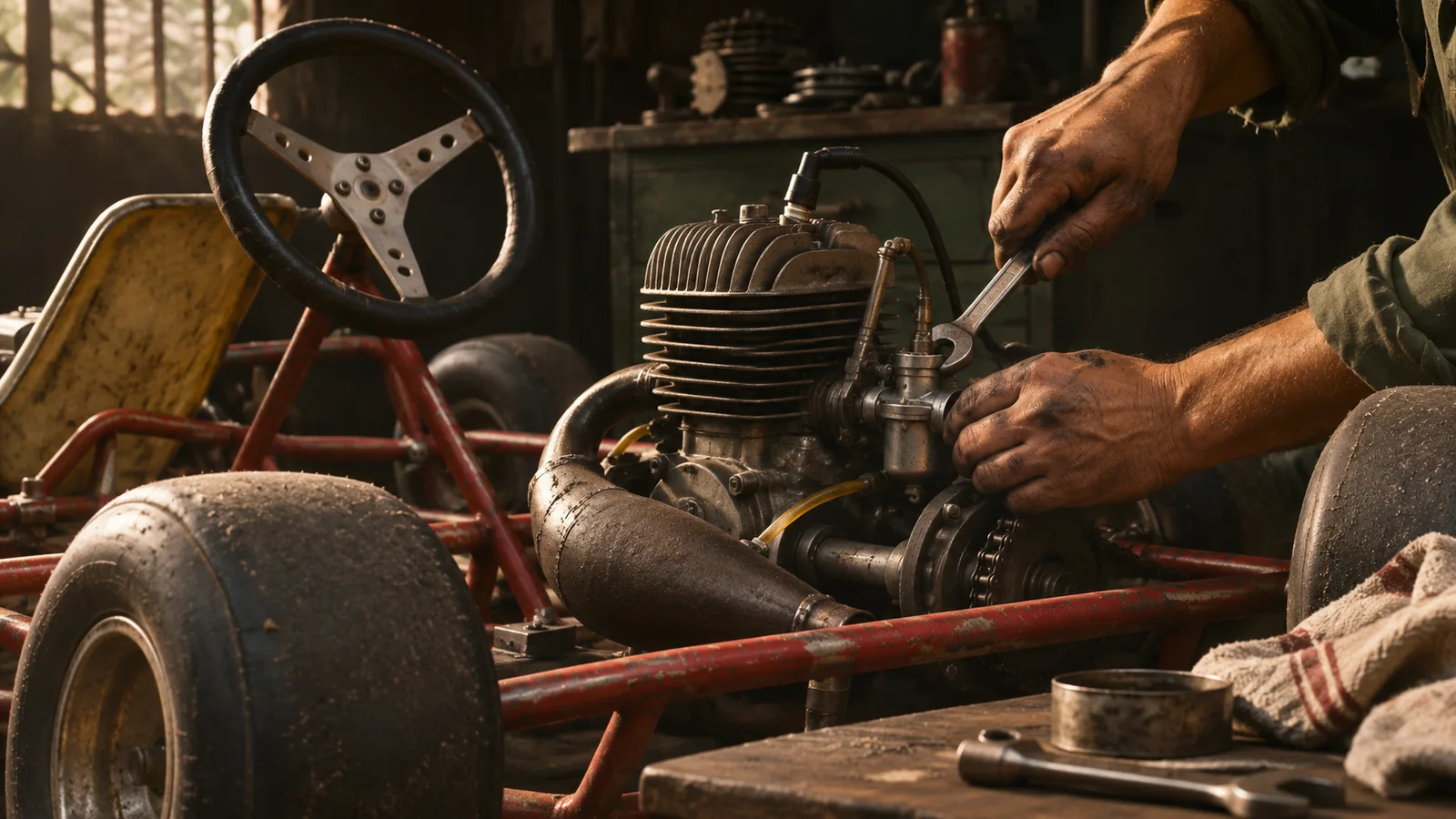
Imagined hands at work on a period kart. No specific mechanic or workshop session is identified.
Why a kart leaves so little hidden
A kart is small enough for the relationship between a driver’s choices and the vehicle’s response to feel immediate. There is no elaborate suspension system isolating him from the surface. Momentum matters: a slow exit can damage the next straight, and a mistake made in one corner can remain visible several corners later.
For a young competitor, that closeness teaches more than courage. It teaches where speed is being lost. Looking after the machinery, listening to a mechanic and comparing changes become part of driving. Talent needs a vocabulary before it can tell someone else what the kart is doing. Senna’s later reputation for detailed technical involvement makes these early working relationships worth noticing.
Italy, DAP and Terry Fullerton
In 1978, Senna joined the Italian DAP operation. His teammate Terry Fullerton had already been world champion in 1973. The Brazilian arrived as a gifted newcomer; the British driver possessed the experience he still needed. In Fullerton’s recollections, the early relationship included learning, improving communication and travelling to races together.
This was an apprenticeship with a difficult condition attached. The person who could show him how to become better also stood between him and victory. Fullerton remembered a relationship that became friendlier as Senna’s English improved, then more strained as their competition intensified. It is an early example of a pattern that would return in larger garages: closeness and rivalry developing at the same time.
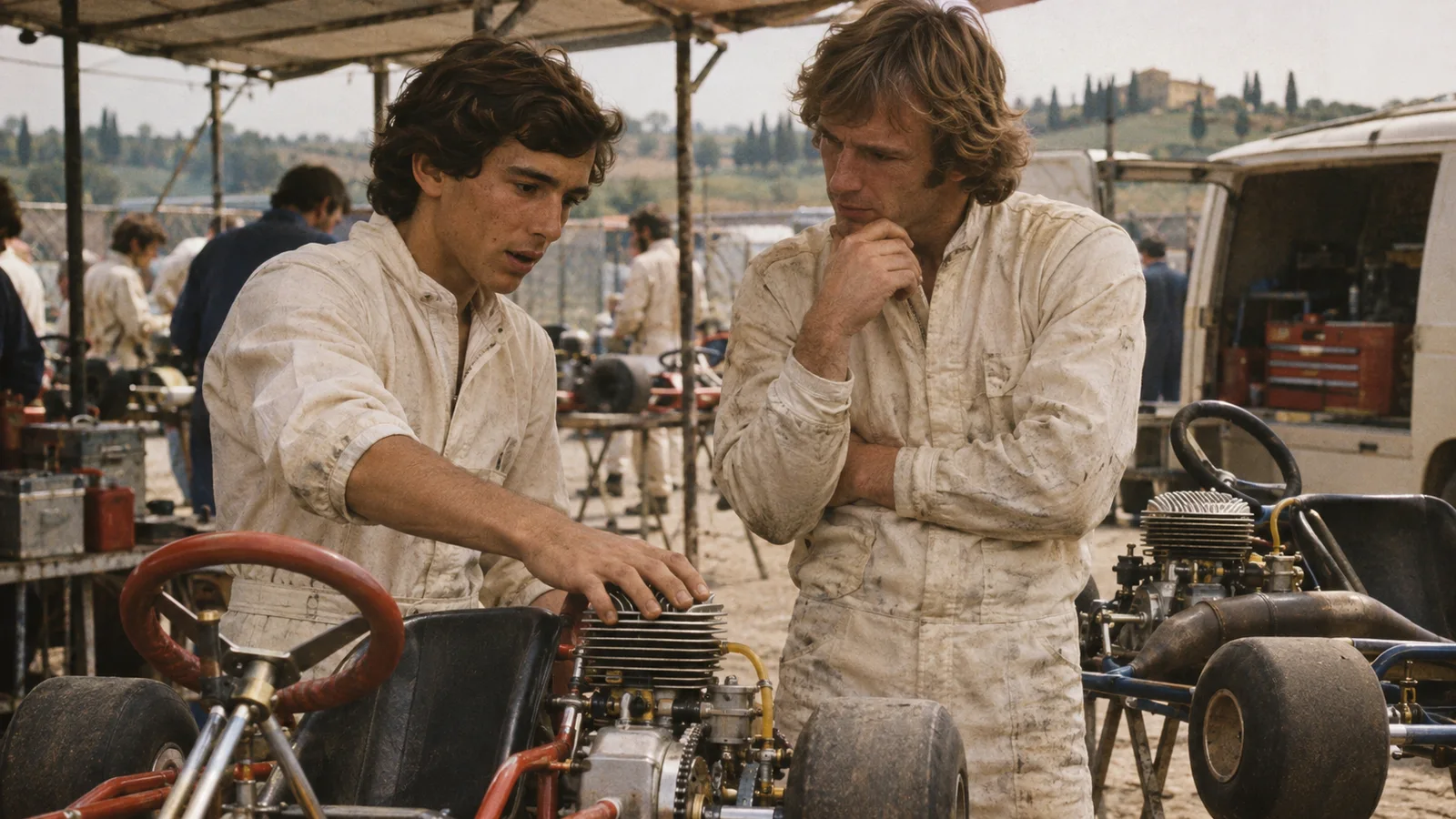
An imagined DAP paddock interaction illustrating the Senna–Fullerton years. No conversation or specific meeting is documented by the image.
The title that stayed out of reach
Senna finished second in the world karting championship in both 1979 and 1980. The results matter because they interrupt the idea that greatness announces itself through an uninterrupted series of titles. He could be extraordinarily quick and still leave the most important competition without the prize he wanted.
The world championship also widened his working world. Different circuits, unfamiliar languages and competitors from other countries demanded adaptation. The journey toward Formula One was already international before he moved to Britain to race cars. Europe was not merely a destination at the end of his Brazilian childhood; it became a place where his confidence had to be tested against other people’s expertise.
The rival he remembered
Much later, when Senna was asked which opponent had given him the greatest satisfaction to race, he named Fullerton. The answer reached back past the famous Formula One antagonists to the DAP years. It suggests how firmly those early contests remained part of his own account of becoming a driver.
Fullerton stayed in karting while Senna moved into cars. Their paths would not lead to the same kind of fame, but that does not make the earlier rivalry a minor one. For a young Ayrton, the world champion beside him was the immediate measure of what excellence required. Before Prost, there had been a teammate he wanted both to learn from and to beat.
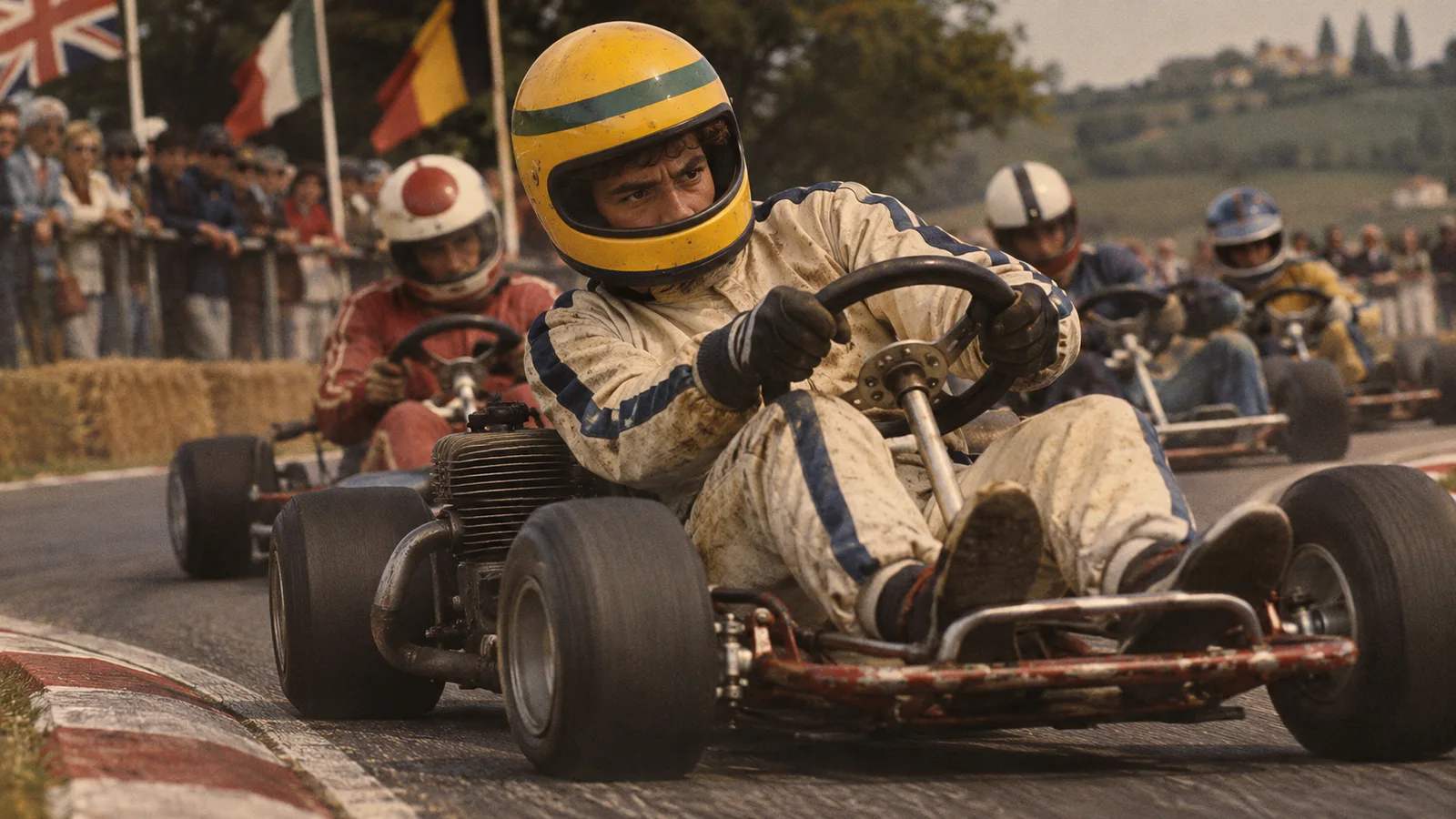
An interpretation of late-1970s international kart competition. Not an exact race, lap or finishing order.
A larger machine, a smaller margin for hesitation
By 1981 the next step was a single-seater. A car brought more mass, more speed, a gearbox and a different relationship between engine and chassis. The basic task remained recognisable: understand what the machine needs, feel where it stops cooperating, and find a repeatable way to go faster.
The move also required a different kind of commitment from the family. Karting trips had become a route toward living and working abroad. His father could help fund the opportunity. Ayrton would have to decide what he was willing to leave behind to take it.
THE RECORD BEHIND THE STORY
Sources & perspective
References are connected to the passages above. Recollections retain the perspective of their speakers; technical explanations and editorial interpretation do not imply access to private thoughts. All scene imagery is AI-generated.
01 · Formula 1 · 1 May 2024Who was Ayrton Senna? ↗Career overview and regulatory context. Used alongside race results and participant accounts.02 · Honda · team and engine partnerAyrton Senna: profile, career and records ↗Early karting, championships and career statistics. A participant’s retrospective.03 · Classic Team Lotus · Senna retrospective, pp. 10–11A solid foundation / Driver’s universe ↗Milton and Neyde’s moral and material support, and Neyde’s care for his racing collection.04 · Mike Seymour interviewing Terry Fullerton · Formula 1 · 1 May 2024Road trips, fierce battles and poignant memories ↗First-person recollections by Senna’s DAP teammate. His account includes both affection and conflict.05 · Terry Fullerton · official biographyAbout Terry Fullerton ↗His 1973 world title and DAP partnership with Senna, 1978–1980.06 · Honda · career retrospectiveSenna’s Career, Volume 1: the junior categories ↗Formula Ford progression, return to Britain and the Brundle championship fight. The opening reference to Piquet’s 1980 title is erroneous (his first was 1981); it is not used here.07 · Classic Team Lotus · Senna retrospectiveFormula Ford 1600 ↗Chico Serra’s introduction to Ralph Firman and the Van Diemen apprenticeship.Full bibliography & image disclosure ↗