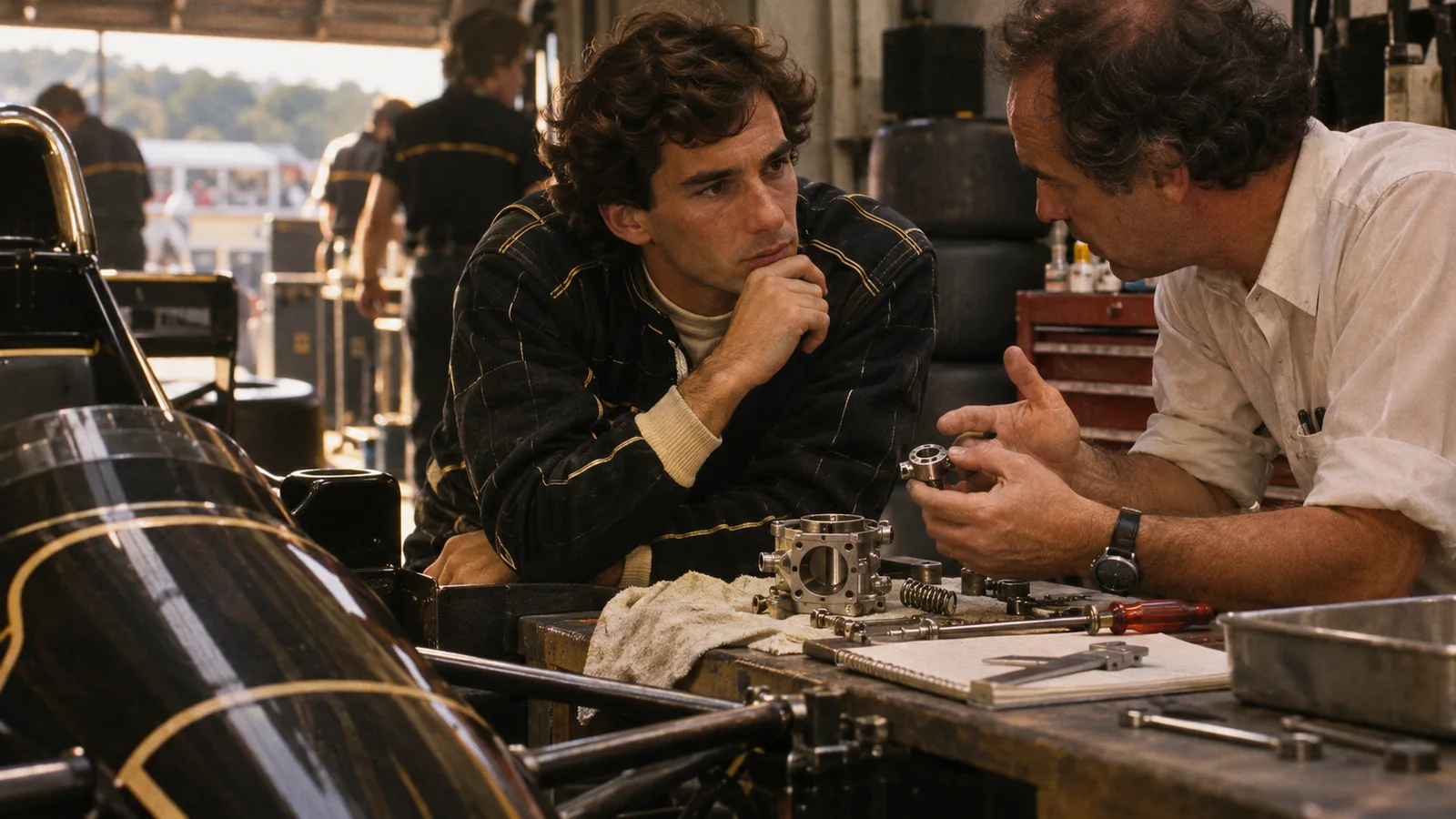
The Lotus years turned a revelation into a race winner. They also made clear how much Senna wanted control of the circumstances around his talent.
In this chapter 6 sections ↓
Estoril, and the first answer
The answer arrived in his second race for Lotus. On 21 April 1985, Senna took pole at Estoril and led the Portuguese Grand Prix through persistent rain to his first Formula One victory. It was a result large enough to change the expectations surrounding him, not merely confirm that Monaco had been impressive.
His race engineer Steve Hallam later remembered the conditions and the practicality of the team’s departure. The cars still had to be packed away in the wet, and a flight had to be caught. Even this first victory ended inside the working rhythm of a racing team. That rhythm matters: a driver’s extraordinary afternoon depends on other people finishing their jobs.
FOLLOW THIS STORYFollow the first victory, from the grid to the return to the garageThe speed of a qualifying specialist
Seven pole positions in 1985 showed how often Senna could find exceptional speed over a lap. A second victory came at Spa. Yet a championship requires the car to remain competitive and reliable across a whole season, through tracks and conditions that do not all favour it equally.
The Renault turbo was part of this challenge. Exhaust energy helped force more air into the engine, producing power with a response the driver had to anticipate. On a corner exit, applying the throttle was not just asking for acceleration in the present; it was preparing for the power that would arrive as the car straightened. Mechanical understanding and commitment were becoming harder to separate.
Jerez: fourteen thousandths
At Jerez in April 1986, Nigel Mansell’s late tyre stop gave him fresh grip for a pursuit of Senna. The gap fell until the Williams was almost alongside at the finish. The Lotus crossed the line first by 0.014 seconds. A result so narrow makes the familiar phrase “on the limit” unusually concrete.
It was also a tactical contest. Mansell traded time in the pits for speed at the end; Senna had to make what remained of his position and tyres sufficient. The race illustrates a different kind of excellence from disappearing into the distance in rain: judging how much can be preserved when a rival’s immediate performance is stronger.
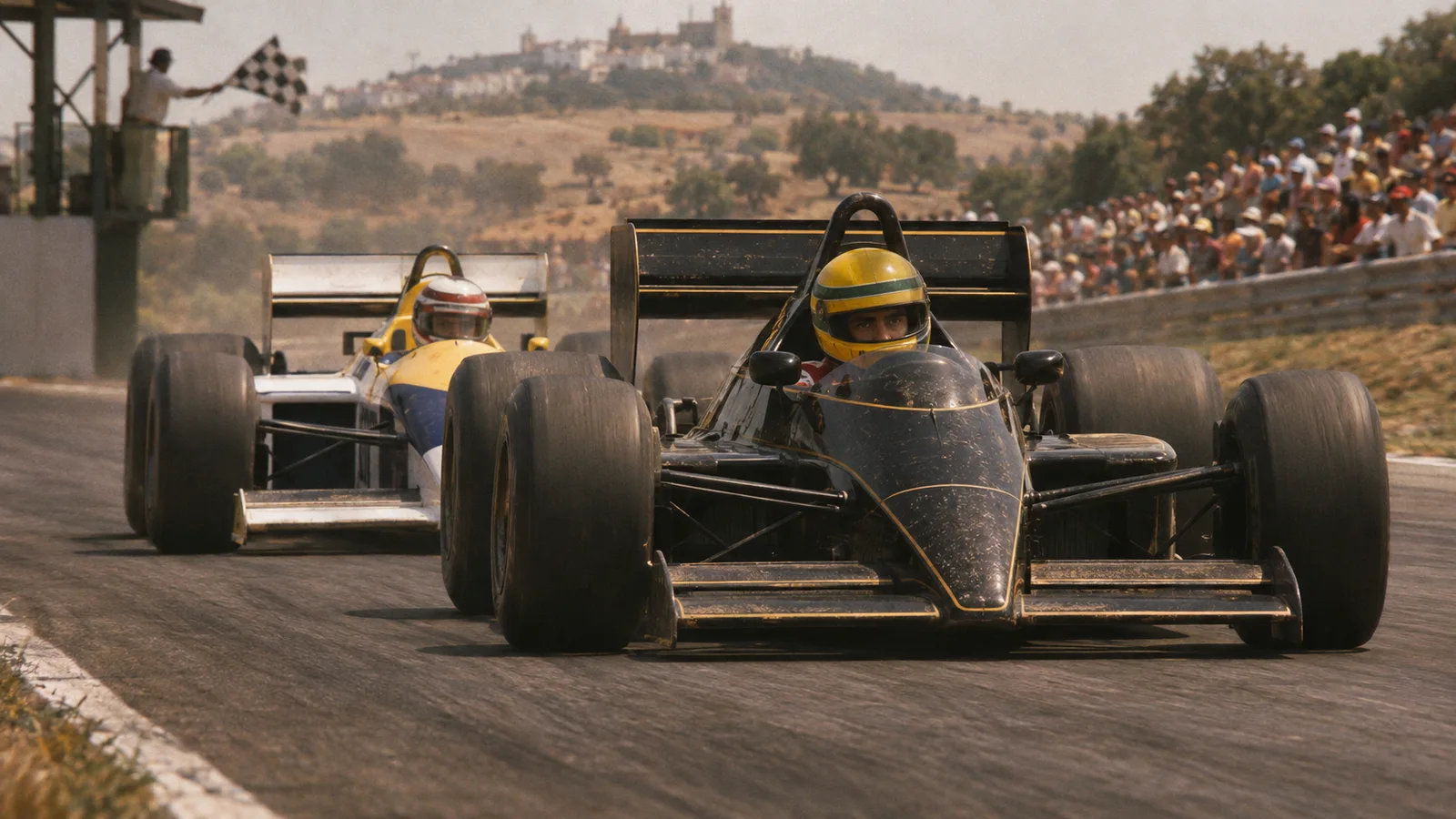
An artistic interpretation of the Lotus–Williams contest at Jerez in 1986. Not the exact finishing instant.
Whose team would it be?
Senna opposed Lotus hiring Derek Warwick for 1986. The team instead chose Johnny Dumfries. In contemporary comments preserved in the Lotus retrospective, Senna argued about the team’s ability to support another established driver alongside his campaign. That was a position of considerable influence for someone only entering his third Formula One season.
From inside his ambition, concentrating resources could look rational. From Warwick’s side, it meant losing an opportunity because another driver resisted sharing the available platform. The episode belongs alongside the brilliant races. Senna was not simply the innocent opponent of racing politics; he could use power within a team to shape his competitive world.
Yellow paint, Honda power
For 1987, the Lotus changed from black and gold to yellow, adopted Honda engines and ran active suspension. Instead of leaving the car’s platform entirely to conventional springs and dampers, the system actively managed its behaviour. The technology promised advantages, but also introduced another layer of development and compromise.
Senna won Monaco and Detroit, successive street-race victories, and finished third in the championship. These were significant achievements for Lotus, but the team was not providing a consistently dominant package. His career had reached the point where winning individual races could no longer satisfy the scale of his objective.
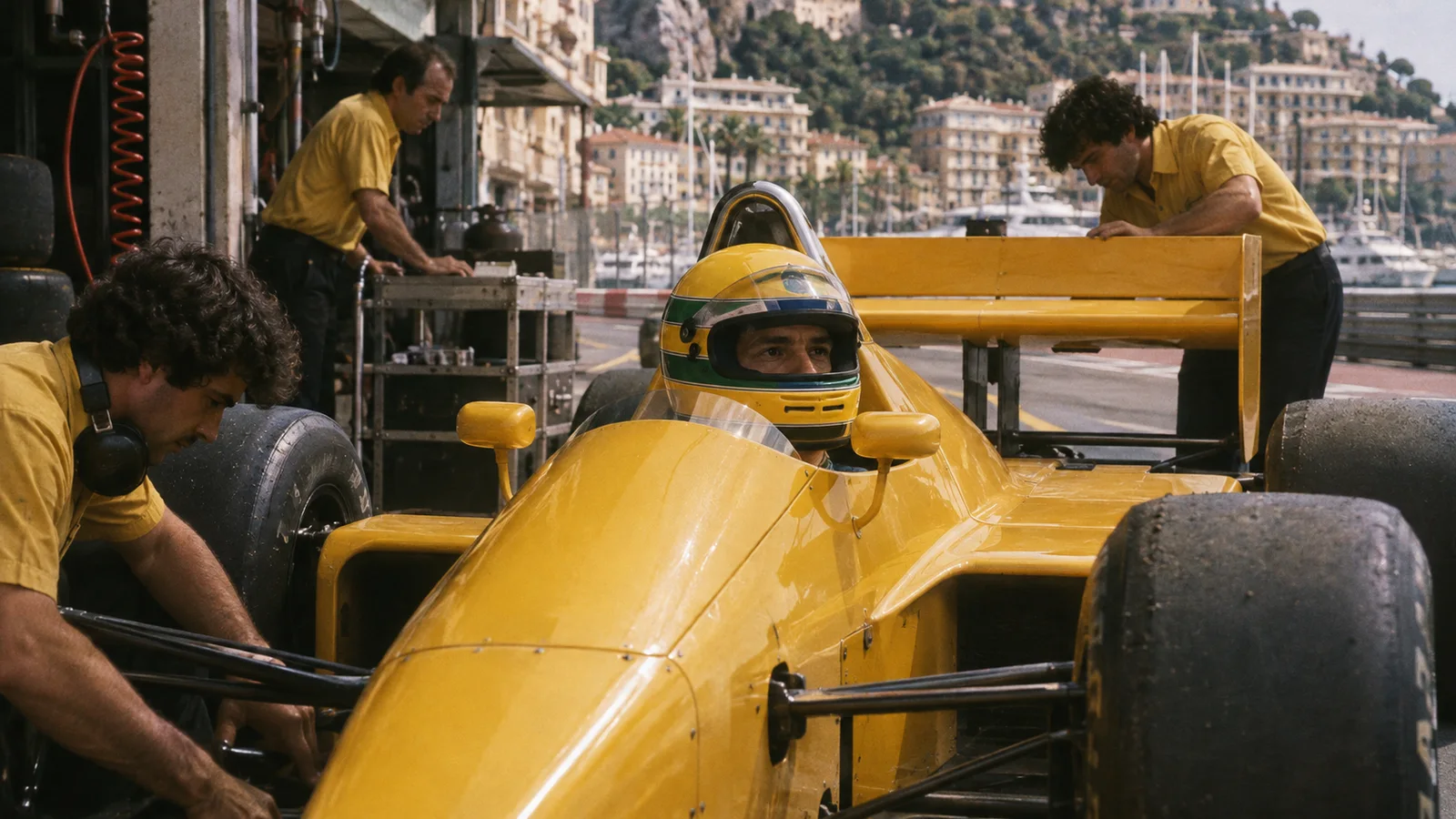
An imagined 1987 Lotus pit-lane scene. Mechanical and circuit details may be approximate.
Toward the strongest possible opposition
McLaren offered the next step, and Honda would be there too. So would Alain Prost, already a double world champion. Unlike the situation Senna had resisted at Lotus, the new arrangement would place an established championship winner across the garage in comparable machinery.
It was an opportunity to remove one explanation for not winning: the idea that the other driver had the better car. It also created an unusually close measure of Senna’s own performance. The championship he wanted now stood within reach of both men, in the same team, on the same Sunday.
THE RECORD BEHIND THE STORY
Sources & perspective
References are connected to the passages above. Recollections retain the perspective of their speakers; technical explanations and editorial interpretation do not imply access to private thoughts. All scene imagery is AI-generated.
01 · Jonny Reynolds · Formula 1 · 21 April 2019Remembering Senna’s first F1 win ↗Includes testimony from race engineer Steve Hallam.02 · RenaultSenna’s first win ↗The 1985 Lotus-Renault season and Estoril’s conditions.03 · Motor Sport · Motorsport DatabaseAyrton Senna: racing biography and results ↗Independent career chronology, including Lotus, the 1987 street-race victories and championship positions.04 · RaceFans · 13 April 2011Senna holds charging Mansell back in F1’s Jerez debut ↗Race reporting retrospective on the 0.014-second finish, tyre changes and the closing chase.05 · Classic Team Lotus · Senna retrospectiveLotus 1986: the choice of a second driver ↗Senna’s opposition to Derek Warwick’s recruitment, with contemporary attributed comments.06 · Honda · team and engine partnerAyrton Senna: profile, career and records ↗Early karting, championships and career statistics. A participant’s retrospective.07 · Formula 1 · April 2014Ron Dennis on Senna: the early years ↗Dennis’s account of recruitment, politics, equality and managing the 1989 team conflict.08 · Beyond the Grid · Formula 1 · 26 September 2018Prost on his career and his relationship with Senna ↗Prost describes supporting Senna’s arrival and their conversations after his retirement. An attributed perspective.Full bibliography & image disclosure ↗