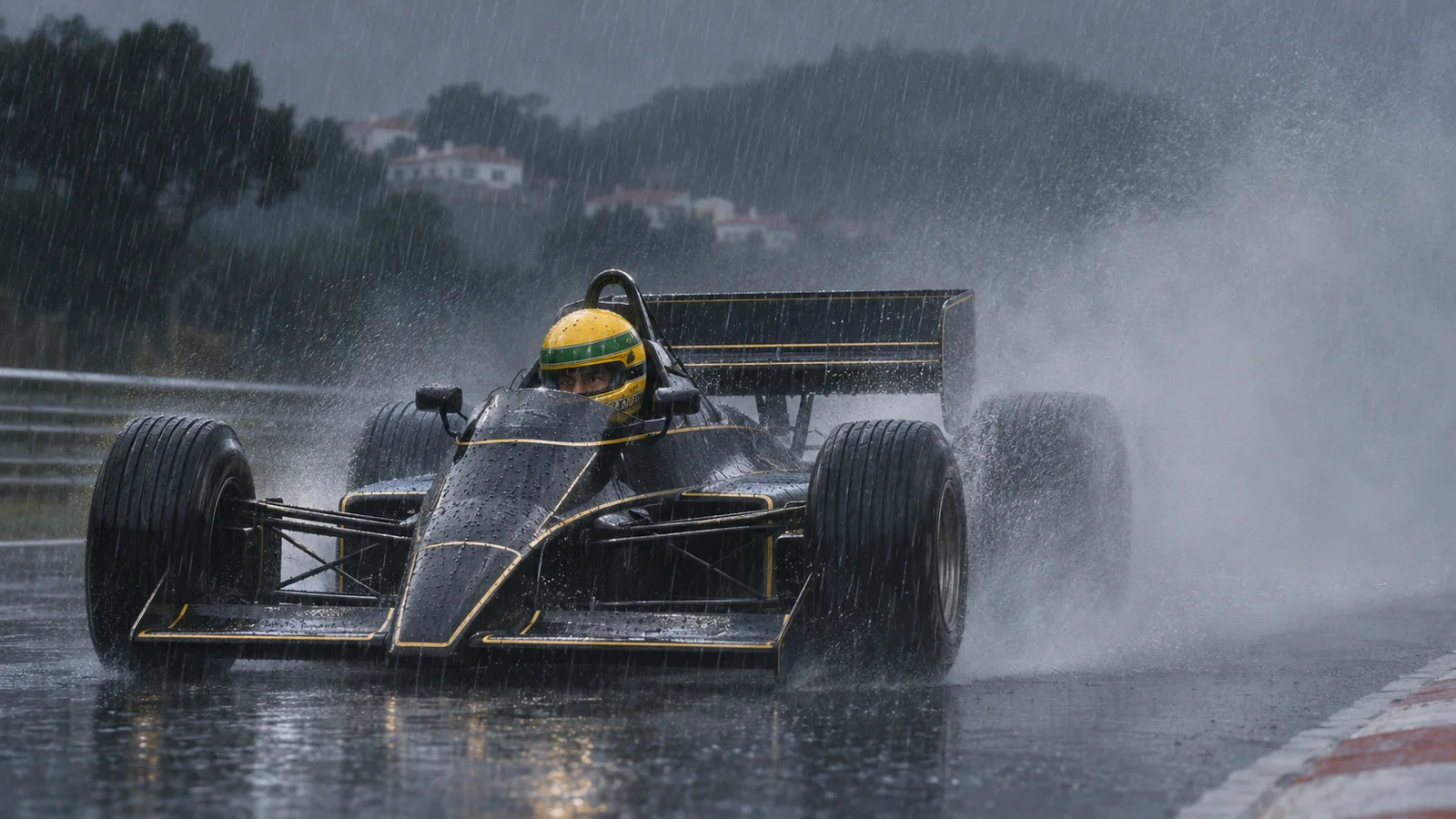
The first win was not a brief flash of brilliance. It required more than two hours of attention, on a surface that could take the car away in a fraction of a second.
In this story 6 sections ↓
Before the rain became a reputation
The 1985 Portuguese Grand Prix was Senna’s second race for Lotus and his seventeenth Formula One start. He had earned his first pole position, putting the black-and-gold 97T at the front before the weather turned the race into something more precarious. A promising grid position was now a responsibility: there was no leading car whose line he could follow.
Rain changes more than the amount of grip. It obscures the boundaries of the track, hides the road in spray and makes the same corner a different problem from one lap to the next. A driver can establish a reference and find that standing water has made it unreliable by the time he returns. The apparent confidence seen from outside rests on continued corrections.
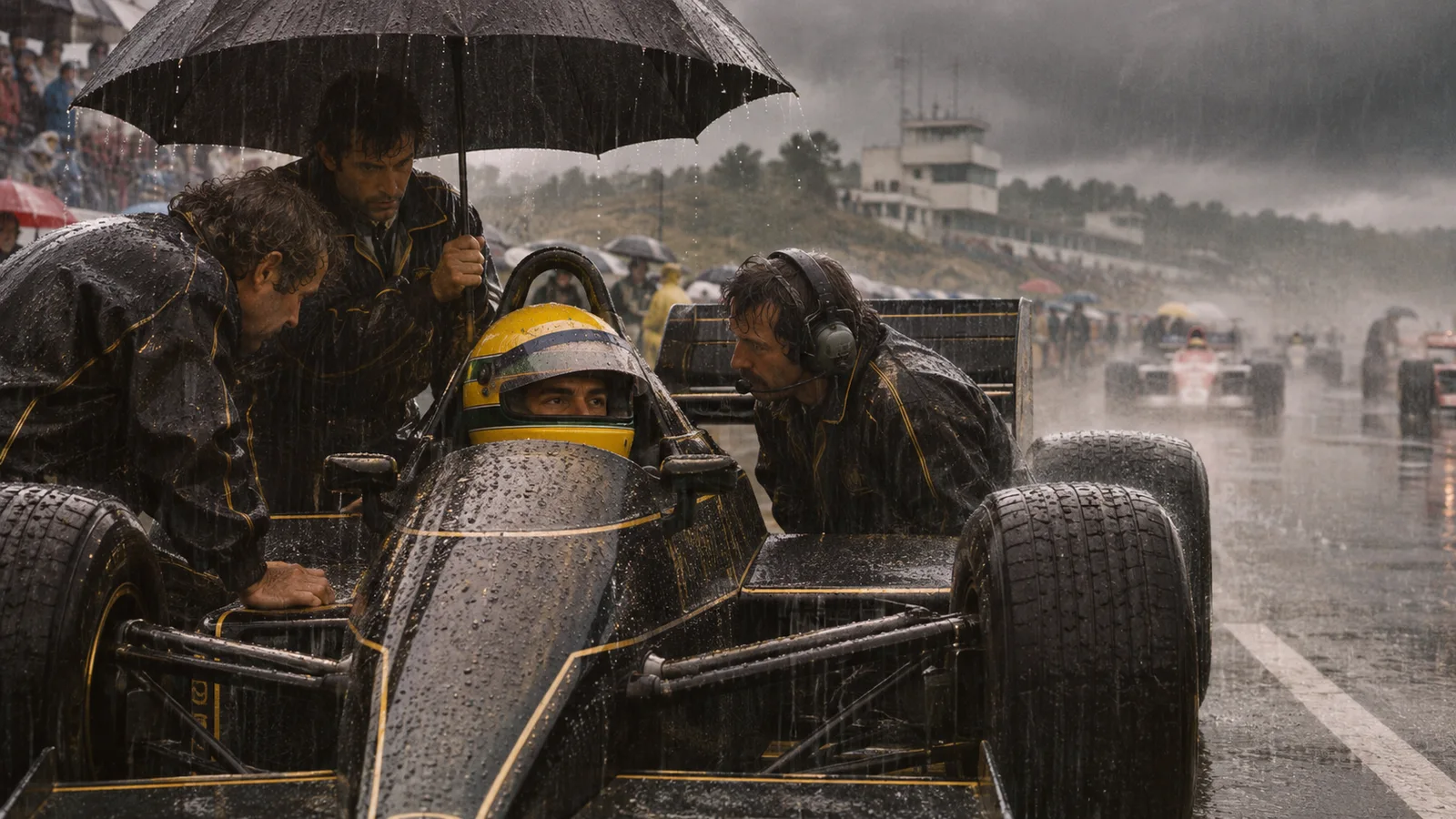
An interpretation of the wet Estoril grid in 1985. Not a documented arrangement of people or equipment.
Power that had to be anticipated
The Lotus’s turbocharged Renault engine provided an additional complication. The driver had to consider how the power would respond after an input, not simply how much throttle the tyres could accept at that instant. A delayed surge that could be managed in the dry might disturb the rear of the car on a wet exit.
The solution cannot be reduced to always being gentle or always being brave. It involves coordinating steering, throttle and the space available as grip changes. The important point is the relationship between them. An impressive steering correction matters less if the preceding decision has already asked too much of the rear tyres.
The field begins to come apart
As the conditions caught out other drivers, Senna remained at the front. The race was not a comparison between him and a field of ordinary competitors. Experienced champions and established winners were trying to keep their cars on the road in the same weather. The strength of the drive lies partly in that company.
Renault’s retrospective remembers aquaplaning on Estoril’s long straights. The huge winning margin should not be read as evidence that he found the afternoon effortless. A result can look serene when its many small recoveries have been absorbed into the driver’s movement and are no longer easy to distinguish from the intended line.
Sixty-seven laps, not one perfect instant
Senna led every lap and set the fastest lap. The official race record gives sixty-seven laps and a winning time of 2:00:28.006. That duration is essential to understanding the performance. A successful response to the first corners had to become a sustainable pattern for more than two hours.
Michele Alboreto finished second, more than a minute behind. The margin described what had happened across the race; it did not free Senna from the requirement to finish the next corner. This is one of the quieter demands of leading: there is no larger gap that makes a patch of standing water or a moment of lost concentration less real.
Back inside the working world
For Hallam and the team, the victory was followed by packing equipment in the wet and getting to the airport. The recollection strips away the idea that a landmark result suspends ordinary work. The car had to be transported, the next race prepared, and the first win turned into something repeatable.
That return to routine is a fitting ending to the afternoon. Senna had not been granted a new kind of immunity. He had demonstrated a level of command that the team would now have to support again. The first win raised the ceiling of expectation, for the driver and for everyone whose work put him on the grid.
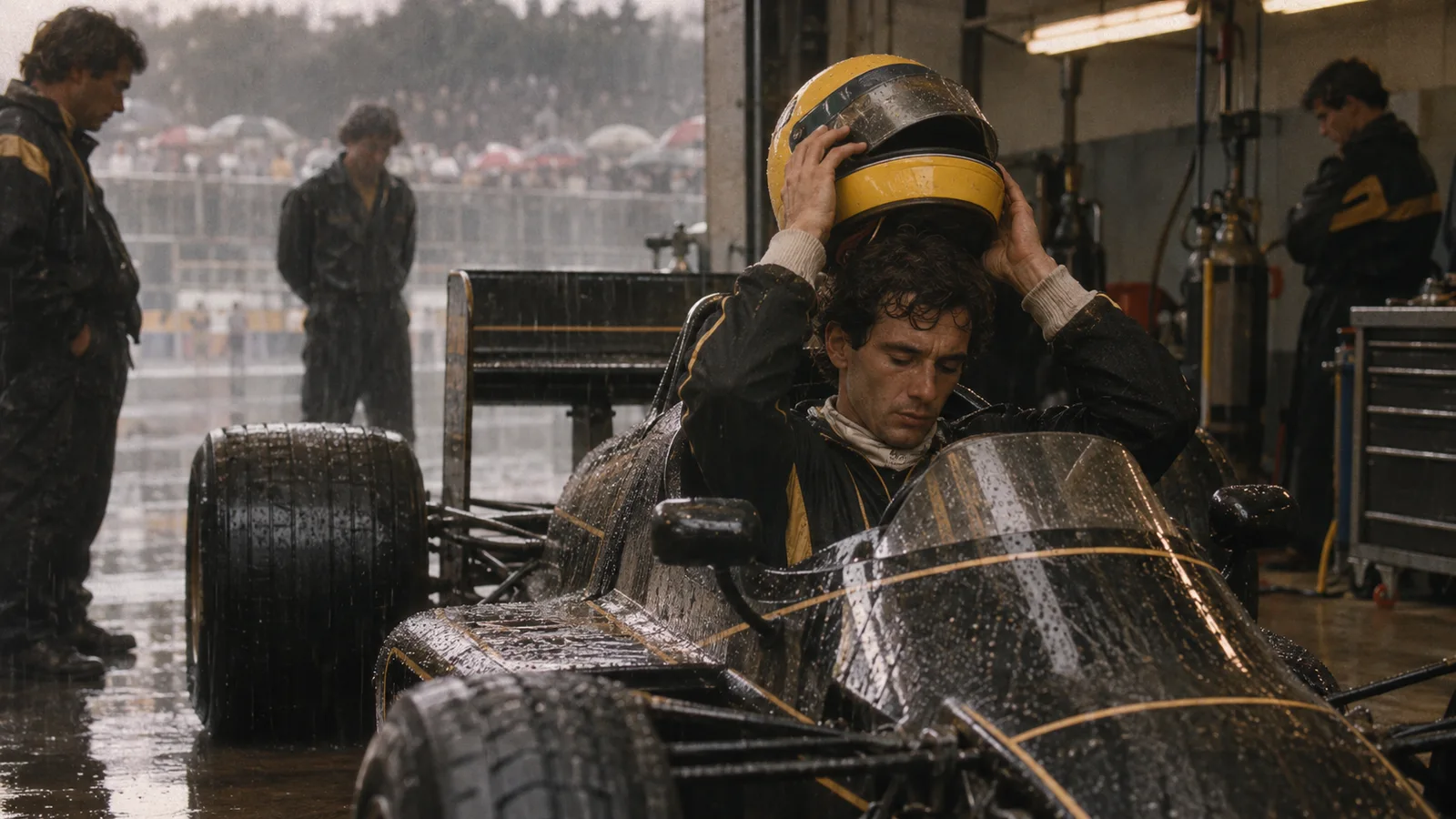
An imagined return to the garage. The victory is documented; this particular gesture and moment are not.
What Estoril made visible
Monaco in 1984 had left an unfinished possibility. Estoril left a completed result: pole, fastest lap, every lap led and victory. The distinction mattered. It supplied the proof that a promise could survive a whole Grand Prix rather than remain a compelling argument about what might have happened.
The image that survives is a black Lotus in rain. The deeper story is a driver and an engineering group making that image possible for the length of an afternoon. His reputation in the wet was becoming a record of decisions that could be followed, rather than a mysterious label attached after the fact.
THE RECORD BEHIND THE STORY
Sources & perspective
References are connected to the passages above. Recollections retain the perspective of their speakers; technical explanations and editorial interpretation do not imply access to private thoughts. All scene imagery is AI-generated.
01 · Jonny Reynolds · Formula 1 · 21 April 2019Remembering Senna’s first F1 win ↗Includes testimony from race engineer Steve Hallam.02 · RenaultSenna’s first win ↗The 1985 Lotus-Renault season and Estoril’s conditions.03 · Formula 1 · official season results1985 race results ↗The Portuguese Grand Prix date, 67 laps and winning race time of 2:00:28.006.04 · Formula 1 · 2 May 2014Vital statistics: Ayrton Senna ↗Historical totals. Any all-time rankings in this 2014 article are dated and are not repeated as current rankings.Full bibliography & image disclosure ↗