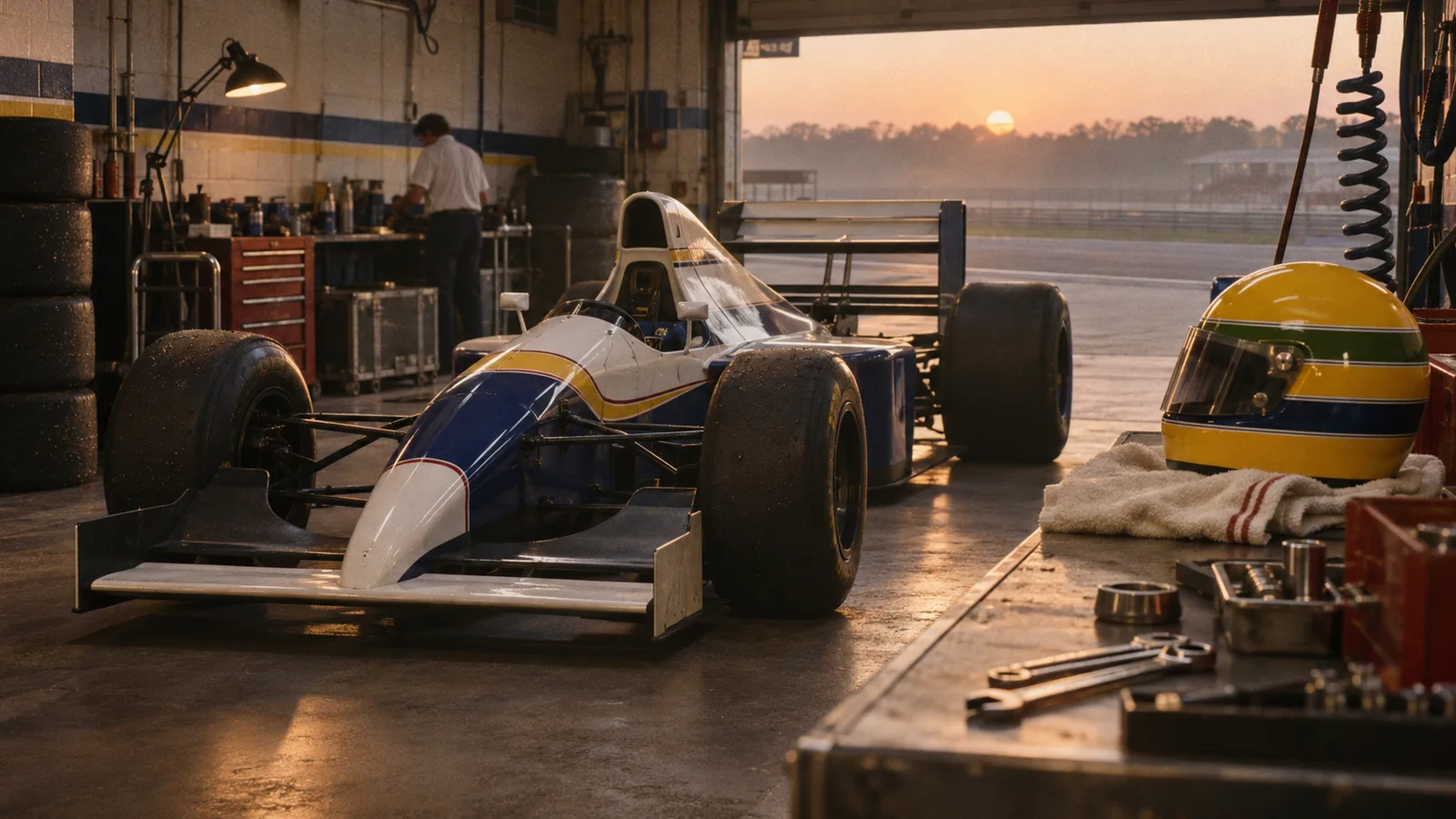
Williams was supposed to be a new beginning. The final chapter of his racing life must leave room for that unfinished future, and for the other people whose lives were changed at Imola.
In this chapter 6 sections ↓
A team he had chased for years
Senna joined Williams for 1994 after watching it set the championship standard in the previous two seasons. The opportunity arrived just as the technical landscape changed. Electronic driver aids, including active suspension, were banned, and the FW16 had to deliver its performance through a different mechanical and aerodynamic balance.
Formula One’s technical retrospective describes the car’s difficult early behaviour as Williams adjusted to passive suspension. That explains a performance problem, not the cause of the accident that would follow. Senna still put the car on pole for the first three races. The speed was visible before the team had found a dependable way to convert it into finishes.
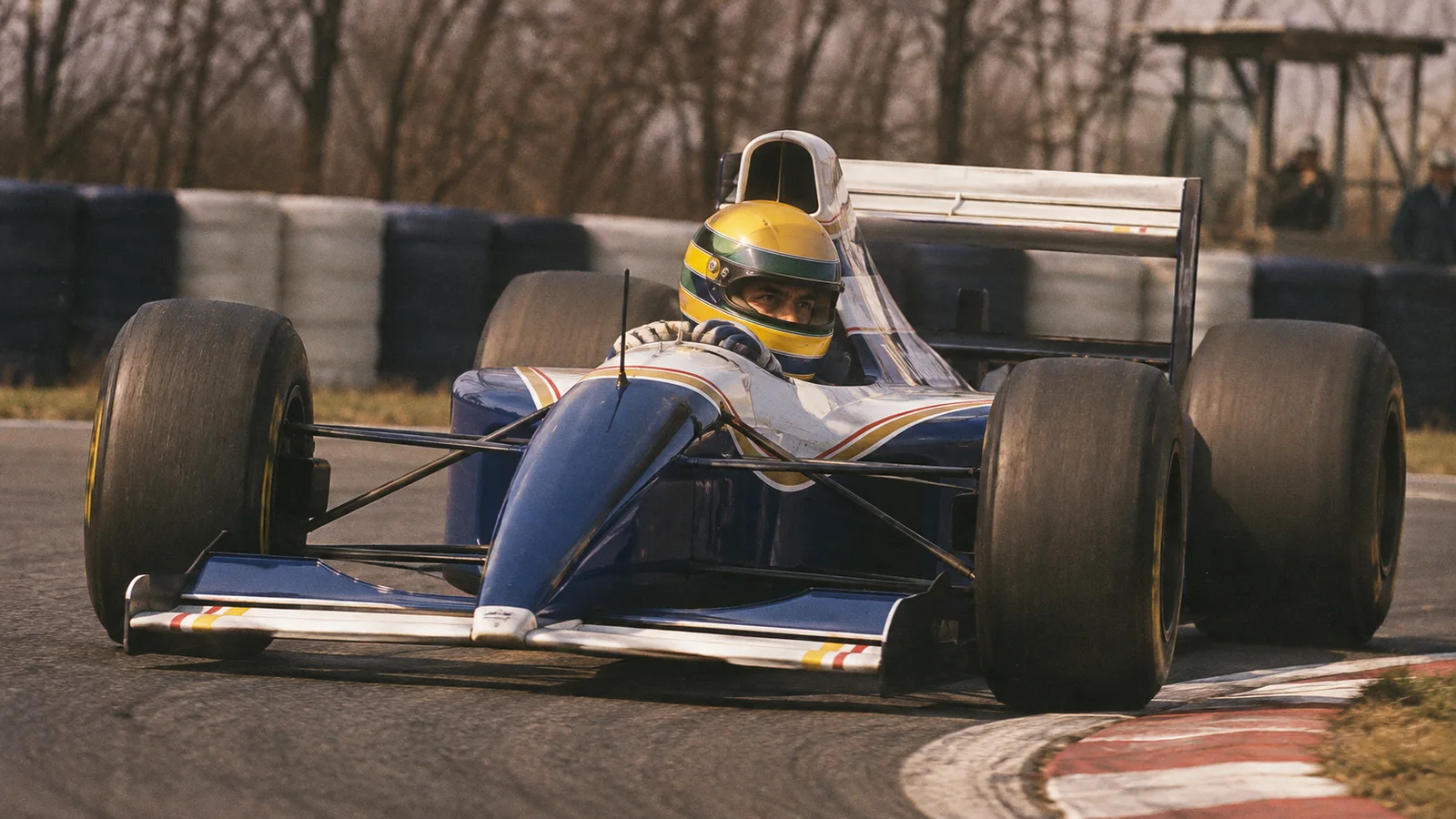
An imagined early-1994 Williams test. It does not depict the accident or establish its cause.
Two races, no points
The opening race in Brazil ended with a spin while he pursued Michael Schumacher. At the Pacific Grand Prix at Aida, first-corner contact ended his race before he had an opportunity to build a result. He arrived at Imola without championship points, in a season that had begun with the expectation that he would again be a central title contender.
The familiar name and the new colours can make it tempting to treat this period only as a prelude to tragedy. But he was living a working problem: how to master an unsettled car, understand the opposition and recover the season. The story was not finished in his plans. That is part of what makes its interruption so difficult.
Friday, then Saturday
The San Marino Grand Prix weekend brought a serious practice accident for Rubens Barrichello on Friday. On Saturday, Roland Ratzenberger died during qualifying. Before Sunday’s race began, the paddock had already been confronted by both the fragility of a young colleague and the death of another.
Ratzenberger was an experienced racer arriving in Formula One with the new Simtek team. David Brabham, his teammate, remembered a quick, capable and complete driver. His career had required years of work before this opportunity. He belongs in the account as a person with a history of his own, not simply as the name that appears before Senna’s in the chronology of a terrible weekend.
An imagined contemplative Imola environment, not an archival record of the weekend or final hours.
Sunday, 1 May 1994
Senna started from pole and was leading when his Williams left the circuit at Tamburello. He died that day, aged thirty-four. Ratzenberger had been thirty-three. These are the facts around which the weekend is remembered; there is no need to imagine a final thought or turn the impact into a spectacle.
For Milton and Neyde, a son had died. For Viviane and Leonardo, it was a brother; for friends and colleagues, someone with whom ordinary future plans had still been possible. The scale of the public loss can obscure the intimate one. A person had been taken out of relationships that did not exist for the benefit of a sporting legend.
The work that followed the silence
The deaths accelerated an already developing effort to make racing safer. Formula One’s safety history is careful about that distinction: Imola did not invent concern for safety, but it sharpened urgency and brought new pressure to changes in circuits, cars, procedures and research.
Progress took years and involved many people. It is better understood as continuing work than as a single change that could make racing safe forever. The questions raised by 1994 travelled far beyond the particular corner or the particular car. What could be prevented? What could be learned? Which risks had become too familiar to be adequately questioned?
An imagined commemorative scene, not an archival image of the 1994 weekend.
Remembering both names
At later commemorations in Imola, flowers and silence have honoured Senna and Ratzenberger. Brabham’s recollections ask the sport to keep his teammate’s memory beside that of its more famous champion. Equal attention does not require equal fame. It requires recognising what was lost.
Senna’s racing career stopped at forty-one victories, sixty-five poles and three titles. His life cannot be completed by imagining the championships that might have followed. Its next real chapter belongs to the people who survived him: the family who carried his memory, the colleagues who pursued safer racing, and the children whose opportunities would become the centre of a different kind of work.
THE RECORD BEHIND THE STORY
Sources & perspective
References are connected to the passages above. Recollections retain the perspective of their speakers; technical explanations and editorial interpretation do not imply access to private thoughts. All scene imagery is AI-generated.
01 · Formula 1 · technical retrospectiveWhen new regulations caught teams out: the FW16 ↗The difficult switch to passive suspension. General performance context, not a finding on the cause of Senna’s accident.02 · Formula 1 · 1 May 2024Who was Ayrton Senna? ↗Career overview and regulatory context. Used alongside race results and participant accounts.03 · Formula 1 · 1 May 2014Moments in Time — Ayrton Senna ↗Toleman debut, 1984 Monaco and defining career moments.04 · Matt Youson · Formula 1 · 2 May 2019Imola ’94 and the lasting safety legacy ↗Changes before and after Imola. The article cautions against attributing all subsequent safety progress to one weekend.05 · David Brabham · Formula 1 · 30 April 2024David Brabham remembers Roland Ratzenberger ↗A teammate’s account restores Ratzenberger’s experience and personality to the weekend’s history.06 · Associated Press · 1 May 2024Senna remembered at Imola, 30 years on ↗Memorial for both Senna and Roland Ratzenberger; subsequent safety changes.07 · Formula 1 · 2 May 2014Vital statistics: Ayrton Senna ↗Historical totals. Any all-time rankings in this 2014 article are dated and are not repeated as current rankings.Full bibliography & image disclosure ↗