Long before the helmet became a national symbol, Ayrton belonged to a family in the north of São Paulo. To understand the driver, begin with the people who knew him as Beco.
In this chapter 6 sections ↓
A boy in the north of São Paulo
Ayrton Senna da Silva was born on 21 March 1960, the second child of Milton da Silva and Neyde Senna. His older sister was Viviane; his younger brother, Leonardo, would complete the family. The name used at home was Beco. It belongs to a more intimate history than the surname that would later appear on timing screens around the world.
His childhood unfolded in São Paulo’s northern neighbourhoods, between the growing city and the green heights of the Cantareira. In an excerpt from his biography, Ernesto Rodrigues describes the family’s move in 1964 to a house higher in Santana, with a garden and garage. Milton’s business success was changing the circumstances in which his children would grow up. There was room, money and practical knowledge around them: advantages that would matter enormously when a pastime became competition.
Milton’s small machine
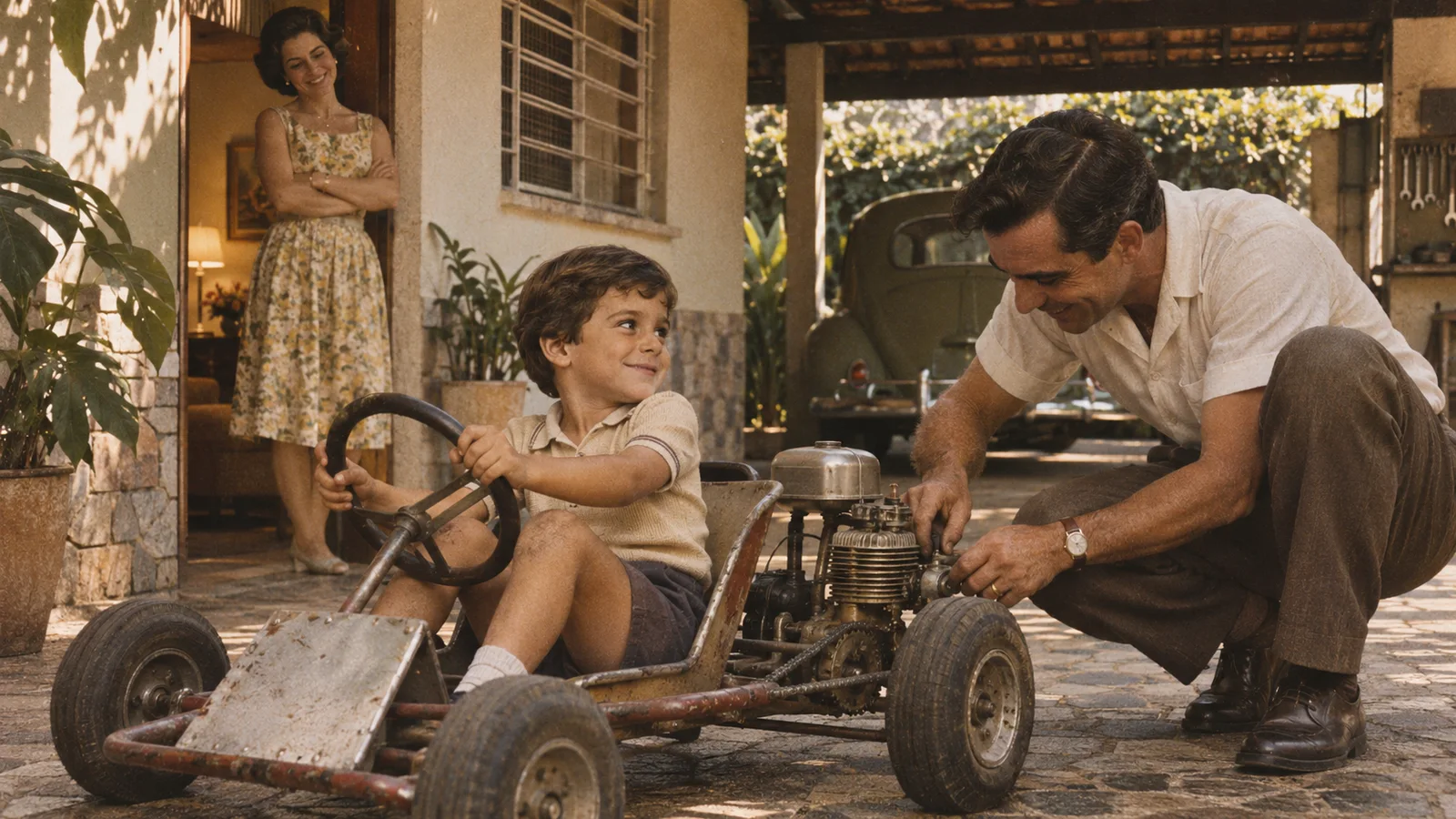
Milton was interested in cars as well as making a living from business. When Ayrton was about four, his father provided a small kart. The familiar origin story is simple, but the relationship inside it is important: a parent was willing to turn a child’s fascination into something he could actually sit in, steer and learn to control.
The kart was not yet a declaration that his son must become a professional driver. It was an opportunity. Ayrton could discover what happened when he moved his hands and feet, make an error, and try again. Later, Milton’s support would extend to the expense of racing. The father’s part in this story was not a single inspired gift; it was the sustained provision of time, equipment and money as the stakes rose.
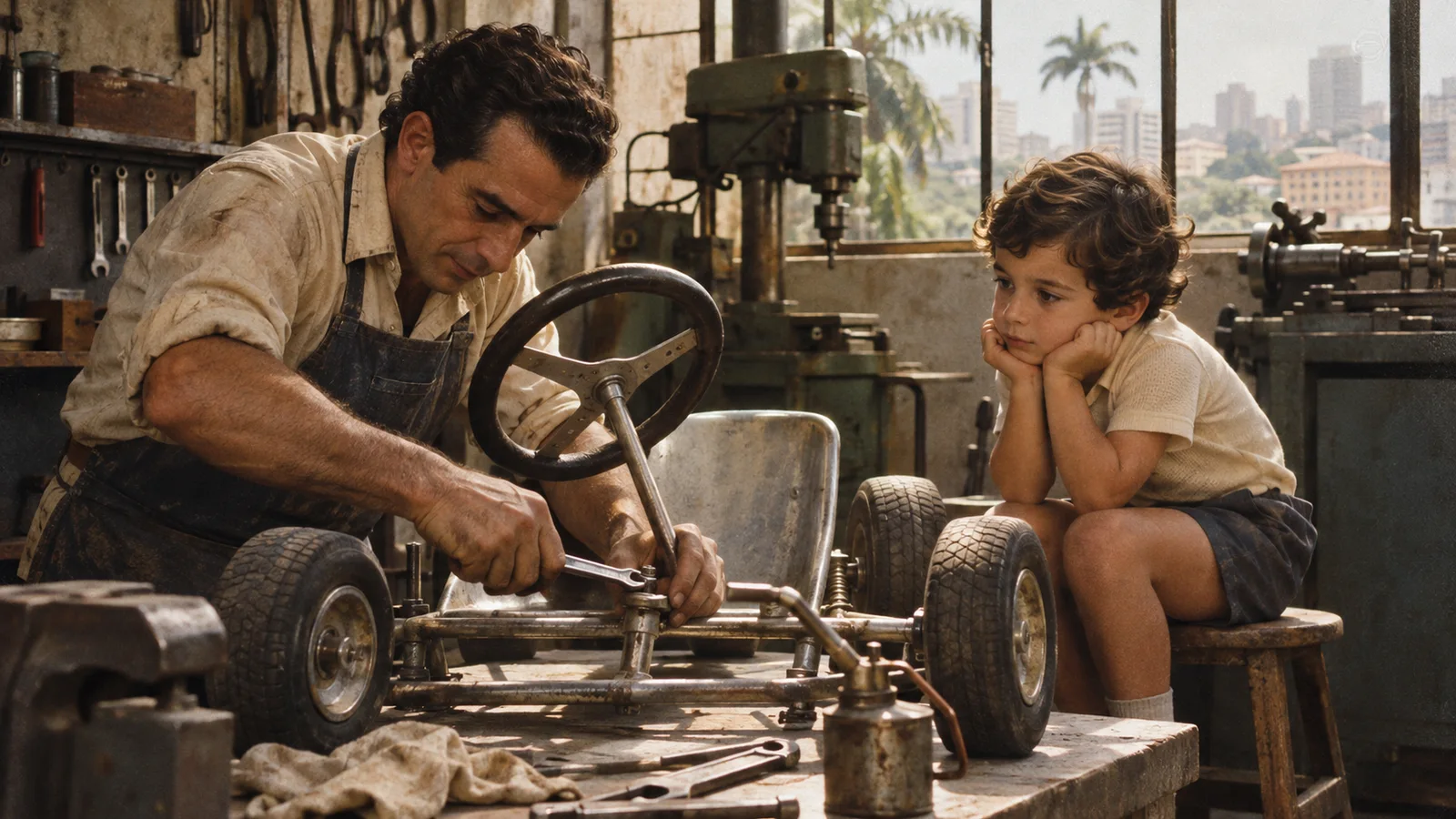
An imagined 1960s family workshop. The early kart is documented; this assembly scene and interaction are not.
Neyde, Viviane and Leonardo
The official family archive remembers Ayrton sharing a room with Leonardo, playing with his siblings and spending time with cousins and neighbourhood friends. In its recollections, family outings matter as much as early laps. One remembered journey to Goiás includes the children stopping to look closely at a sloth and its baby. These are the small discoveries of a child, rather than scenes arranged around a future champion.
Neyde’s contribution remained practical as the racing developed. The Lotus retrospective records her sewing sponsor emblems onto his overalls and removing them when arrangements changed. Later she would preserve the collection he left behind. Racing history often concentrates on the person visible at the wheel; a mother’s patient work is another part of how that person reaches a circuit at all.
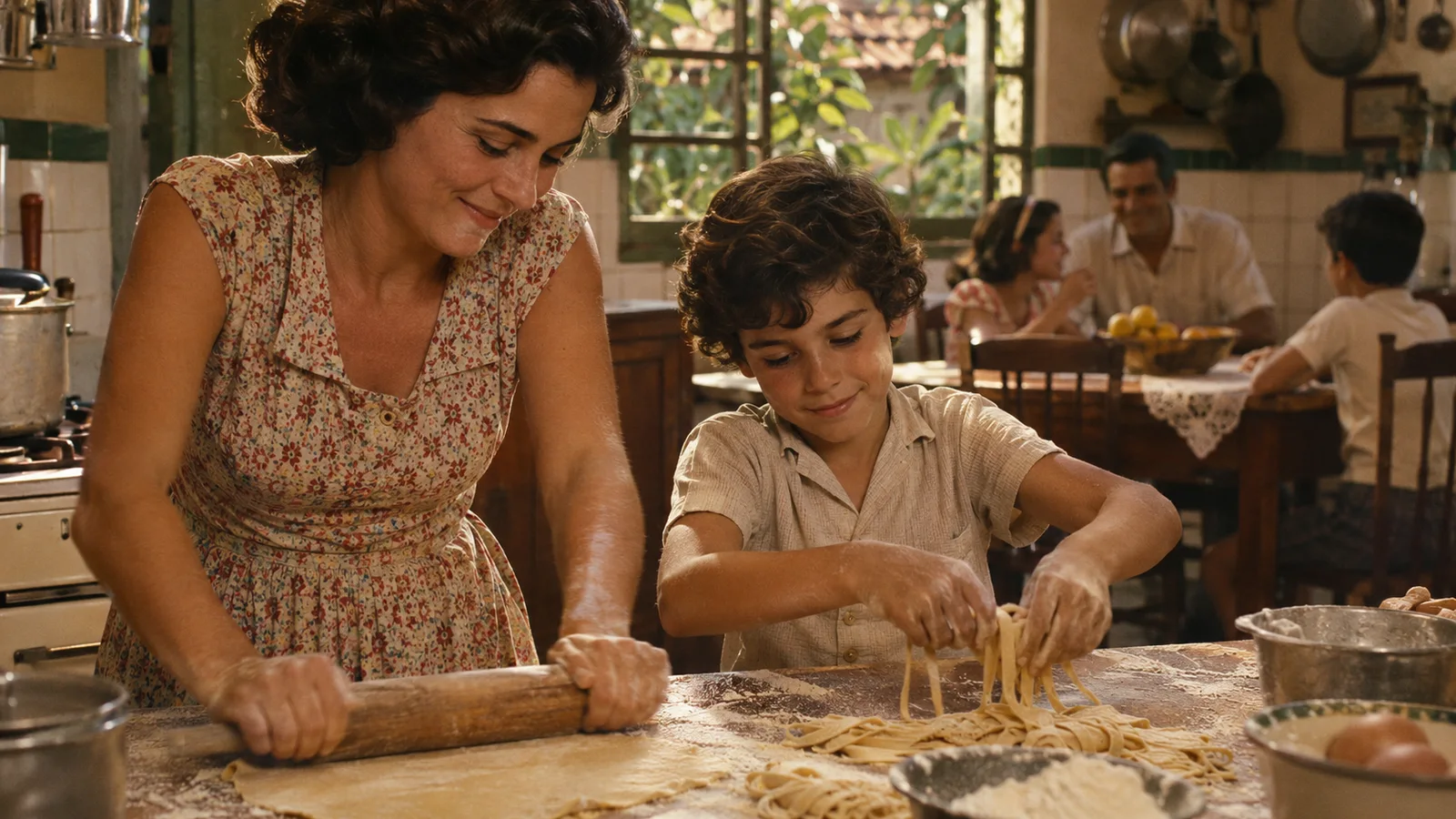
An imagined Brazilian family kitchen in the 1960s. Not a documented family scene or an exact portrait.
The child who did not always get it right
One story Neyde told begins with the family getting ready for a cousin’s birthday. The children had been washed and dressed. In his hurry, Beco climbed across the car toward the driver’s side and leaned against a door that was not properly closed. He fell into a muddy puddle. Viviane and Leonardo laughed; their mother had to begin the preparations again.
It is a recollection of impatience and family comedy, not evidence that every childish action predicted a racing career. Its value is the contrast it preserves. The adult would become famous for an almost intimidating control of himself and his machinery. At home, he had also been the boy who could get everything dirty before the family had even left.
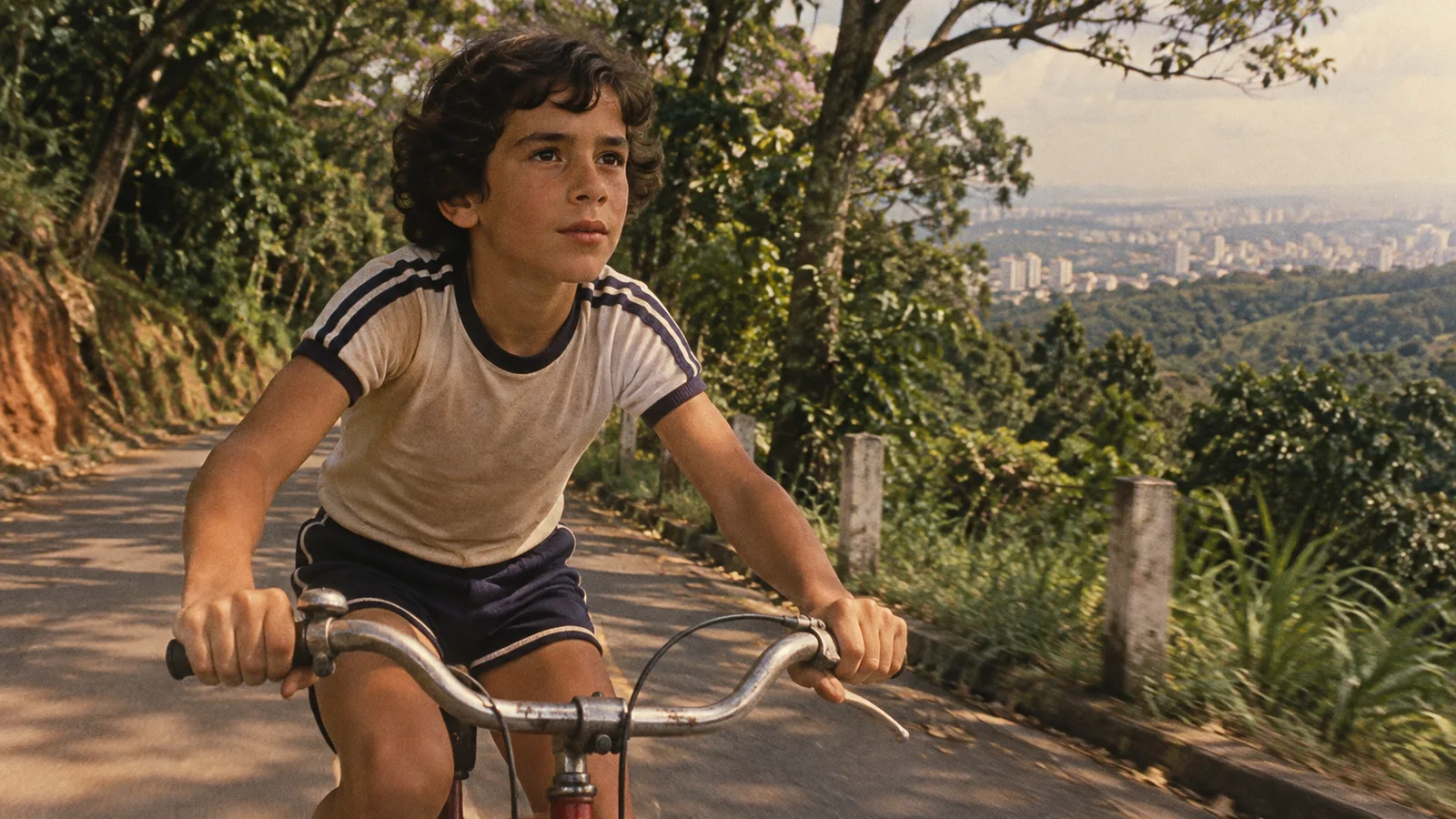
An imagined childhood environment near the Cantareira. Not a record of a particular bicycle outing.
Learning to look at a machine
Rodrigues’s neighbourhood accounts describe a boy who liked watching work in a local mechanical workshop. Looking after the kart gave him reasons to be there. The attraction was not confined to going quickly: it included the objects that made movement possible, and the people who knew how to repair them.
A machine offers a particular kind of education. An adjustment has a consequence. A wheel that does not roll freely, an engine that does not respond cleanly, or a change in surface can be felt. These relationships would grow vastly more complex in Formula One, but the habit of attending to them could begin at an ordinary workbench. The first circuit was a place to play; it was also a place to notice.
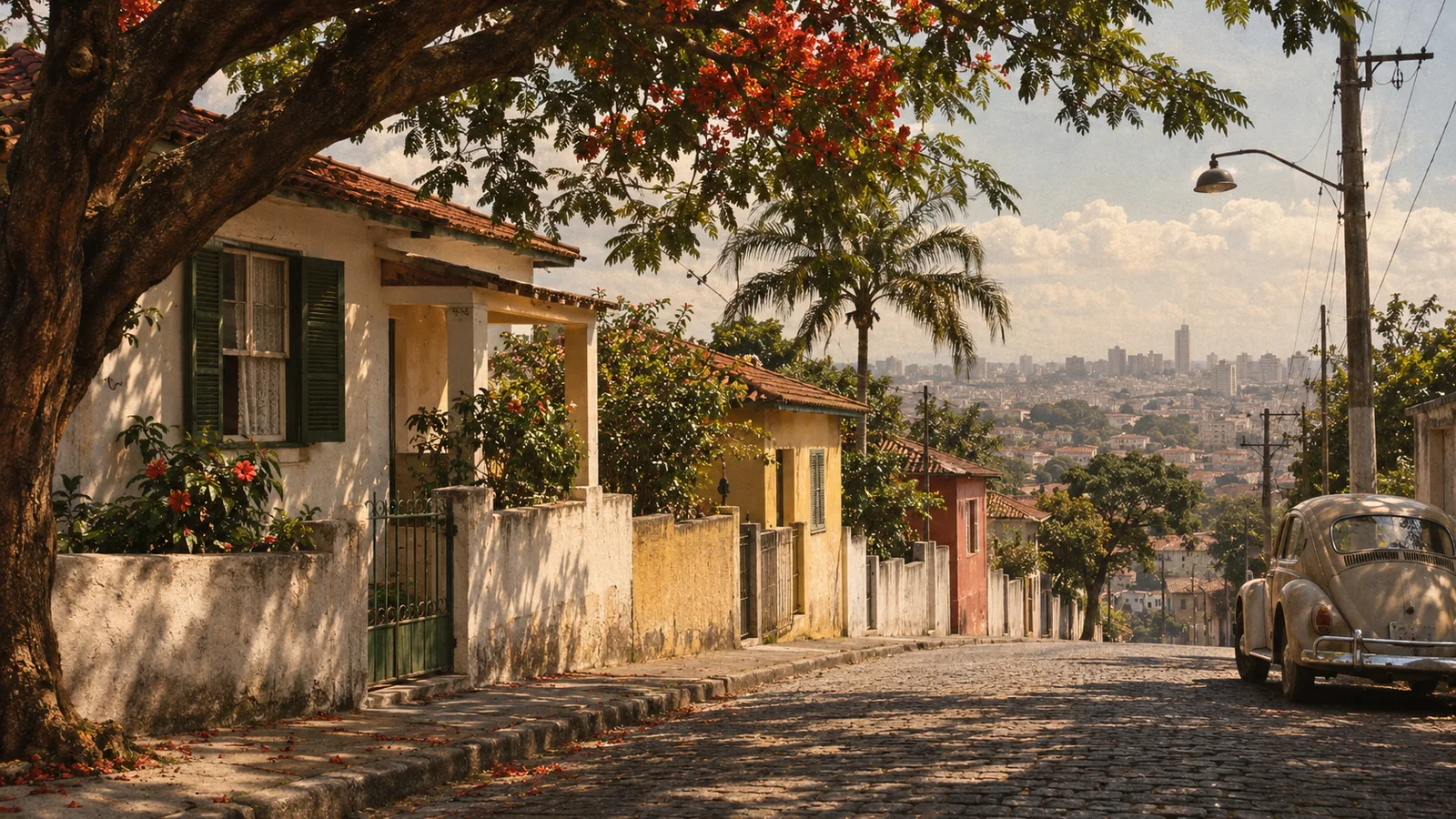
An imagined Santana street in 1960s São Paulo. Not an identified street or family address.
A family’s investment becomes a commitment
Senna did not have to discover a way out of poverty through racing. Milton’s resources gave him access that many equally fascinated children never received. That fact does not explain away his talent. It explains how talent could be given repeated opportunities to develop, rather than being lost after a broken engine or an unaffordable journey.
By his early teens, driving was becoming more than a family amusement. Organised kart racing would bring rules, travel, engines prepared by other people, and opponents who wanted to win just as badly. The next stage would test the speed everyone around him had begun to notice. Beco would have to learn what happened when the other children were fast too.
THE RECORD BEHIND THE STORY
Sources & perspective
References are connected to the passages above. Recollections retain the perspective of their speakers; technical explanations and editorial interpretation do not imply access to private thoughts. All scene imagery is AI-generated.
01 · Senna · official family archiveInfância Ayrton Senna ↗Family recollections and childhood context. Portuguese text may appear on the English route.02 · Ernesto Rodrigues · excerpt published by Folha · 24 February 2010Childhood excerpt from Ayrton: O Herói Revelado ↗Attributed neighbourhood recollections, the family home and early mechanical curiosity. Retrospective biography, not a contemporaneous childhood diary.03 · Classic Team Lotus · Senna retrospective, pp. 10–11A solid foundation / Driver’s universe ↗Milton and Neyde’s moral and material support, and Neyde’s care for his racing collection.04 · Honda · team and engine partnerAyrton Senna: profile, career and records ↗Early karting, championships and career statistics. A participant’s retrospective.05 · Senna · 8 December 2015No Dia da Família: uma história contada pela Dona Neyde ↗A mother’s attributed recollection; memory rather than an independent contemporary record.06 · Formula 1 · 1 May 2024Who was Ayrton Senna? ↗Career overview and regulatory context. Used alongside race results and participant accounts.Full bibliography & image disclosure ↗