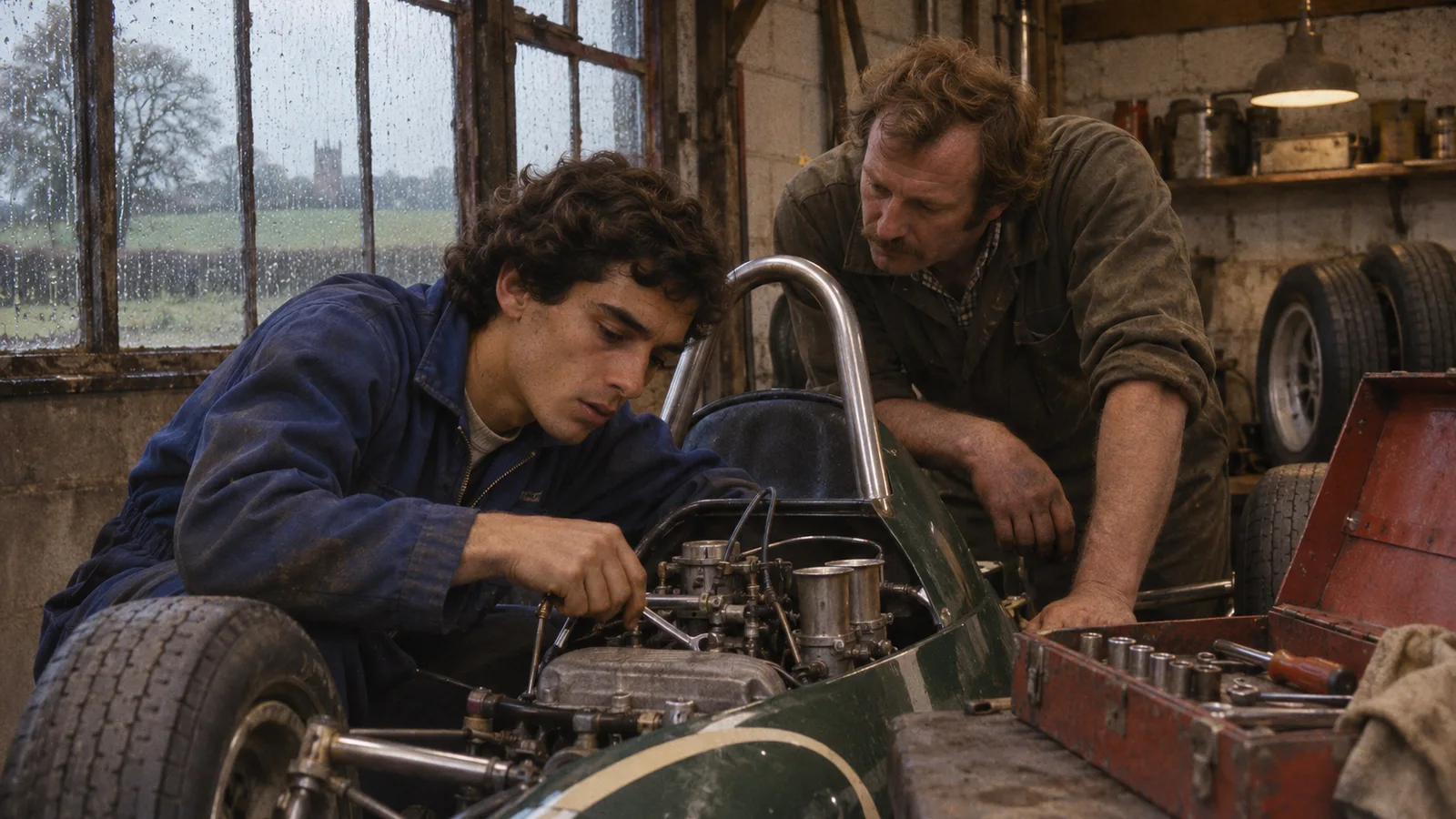
In England, the name on the entry list was still Ayrton da Silva. The young man in the yellow car had to build a new life before anyone could promise him a place in Formula One.
In this chapter 6 sections ↓
Norfolk, 1981
Chico Serra helped introduce Senna to Ralph Firman and Van Diemen, the British constructor whose Formula Ford cars offered a way into European single-seater racing. Norfolk became the centre of a working life far from São Paulo. The move was not the arrival of a finished star. He was another young driver who had to persuade a small racing operation that he was worth its attention.
He had married Lilian de Vasconcellos Souza in 1981, and the marriage belonged to this first attempt at life in England. It ended the following year. The dates are clear; turning the separation into a simple verdict about either person would not be. What the public record shows is that his choice of career was already shaping relationships and the ordinary arrangements of a home.
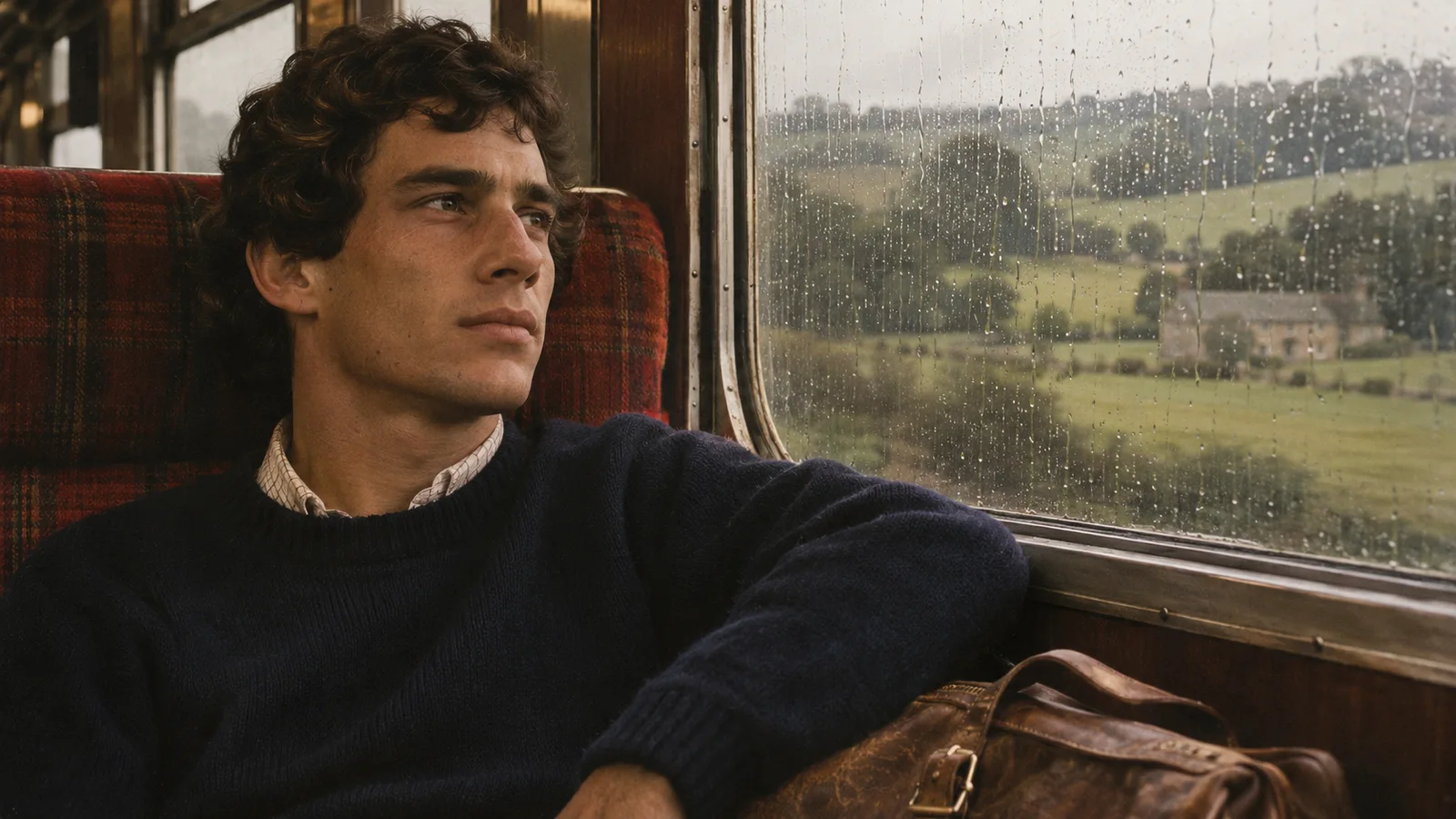
An imagined English train journey in the early 1980s. Not a documented trip or an account of private thoughts.
A car without wings
Formula Ford 1600 was an unforgiving place to hide a weakness. The cars were relatively simple and ran without the wings that would become so important in higher categories. Drivers needed to preserve momentum and make the available power count. A reputation had to be earned repeatedly, often in front of people who knew exactly how much the machinery should be capable of.
Senna won twelve races in his first season and took two British titles. The official archive remembers the laurel wreath from his first car-racing victory being kept by Firman. That small surviving object connects the later world champion to the scale of his beginning: a young man, a successful race in a modest series, and the people who had given him a car.
The return to Brazil
At the end of 1981, Senna went home rather than advancing automatically to the next championship. Honda’s career history describes the problem of securing sponsorship. His father’s business offered an alternative to a career whose costs and uncertainty were increasing. The ladder could have ended after a successful first rung.
He chose to return. The 1982 Formula Ford 2000 campaign brought British and European titles, with twenty-two victories across the two competitions in Honda’s account. The category added wings and greater speed. The decision was becoming visible as a professional commitment: he was no longer simply seeing whether a year abroad might work.
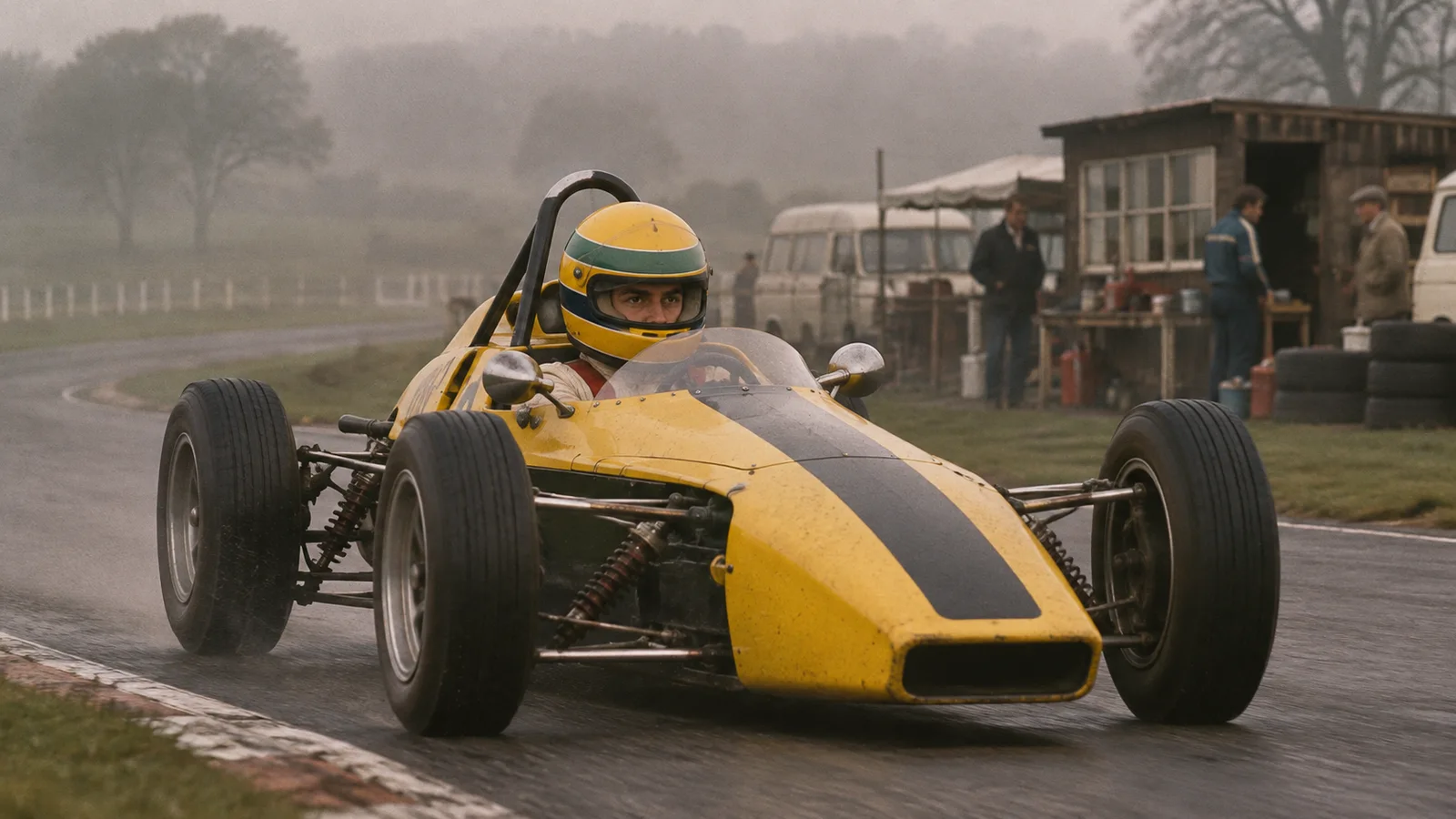
An imagined 1981 Formula Ford practice environment. Car details are illustrative, not an exact chassis reference.
West Surrey Racing and the nine-race beginning
For 1983, he joined West Surrey Racing in British Formula Three. The opening run was extraordinary: victories in the first nine rounds. Yet Martin Brundle kept collecting strong results behind him. A championship that might have looked settled to an outsider was still being kept alive by another driver’s consistency.
That distinction would matter throughout Senna’s career. A spectacular performance can draw the eye while the points table tells a slower, less glamorous story. Brundle’s challenge made the season a test of more than outright pace. Senna had to respond when the early run stopped making the outcome look inevitable.
A title that had to be won again
Brundle’s wins and Senna’s difficulties brought the championship back into contention. The finale at Thruxton decided it. Senna and his engineers found the speed they needed, and he secured the title. The achievement was greater than a summary of the early victories suggests: the championship had survived a genuine challenge.
Formula Three was also a new technical education. Aerodynamic grip increases with speed, encouraging a driver to trust the car more in fast corners while remembering that the same reassurance will not exist in a slow one. Precision becomes inseparable from understanding the conditions under which the machine gives its best. The rapid learning of the karting years was being transferred into a more complex instrument.
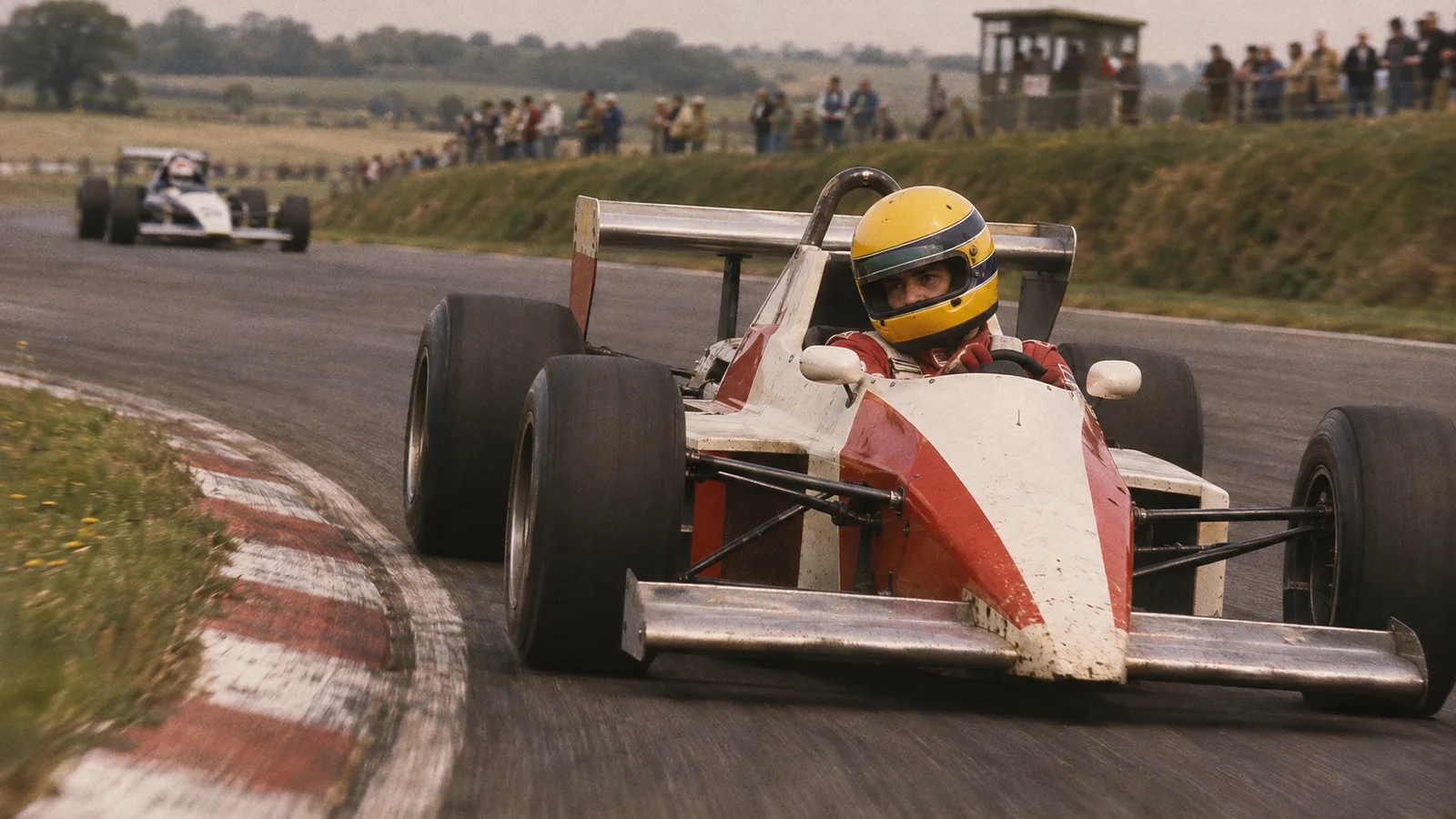
An interpretation of the 1983 British Formula Three setting. Not a specific recorded championship lap.
Macau: speed between the walls
In November, Senna won the first Macau Grand Prix held for Formula Three cars. The event ran in two legs; he won both after taking pole. On the Guia circuit, long fast sections lead into tight, enclosed turns on the hillside. There is little room for an imprecise correction. The museum’s account records his admiration for a circuit that demanded such different kinds of speed.
Macau made the British success legible to a wider field of competitors. Formula One tests and conversations now had a firmer basis than promise alone. He had learned to win in a new country, recover from a difficult championship fight and master an unfamiliar street circuit. The next car would take him into the world he had watched from Brazil.
THE RECORD BEHIND THE STORY
Sources & perspective
References are connected to the passages above. Recollections retain the perspective of their speakers; technical explanations and editorial interpretation do not imply access to private thoughts. All scene imagery is AI-generated.
01 · Classic Team Lotus · Senna retrospectiveFormula Ford 1600 ↗Chico Serra’s introduction to Ralph Firman and the Van Diemen apprenticeship.02 · Mauricio Savarese · Associated Press · 27 November 2024The life behind a new Senna drama ↗Basic marriage dates and public relationships; reporting also cautions about fictionalised historical antagonisms.03 · Honda · career retrospectiveSenna’s Career, Volume 1: the junior categories ↗Formula Ford progression, return to Britain and the Brundle championship fight. The opening reference to Piquet’s 1980 title is erroneous (his first was 1981); it is not used here.04 · Senna · official archiveAyrton Senna’s first win in motorsport ↗The first Formula Ford victory and Ralph Firman’s preserved laurel wreath.05 · David Tremayne · Formula 1 · 1 May 2024Senna vs Brundle: the first great championship battle ↗A reporter who attended the 1983 Formula 3 season looks back.06 · Macao Grand Prix Museum · government museumAyrton Senna da Silva: the 1983 Macau Grand Prix ↗Pole position, both race legs and the demands of the Guia circuit.07 · Formula 1 · 1 May 2014Moments in Time — Ayrton Senna ↗Toleman debut, 1984 Monaco and defining career moments.Full bibliography & image disclosure ↗