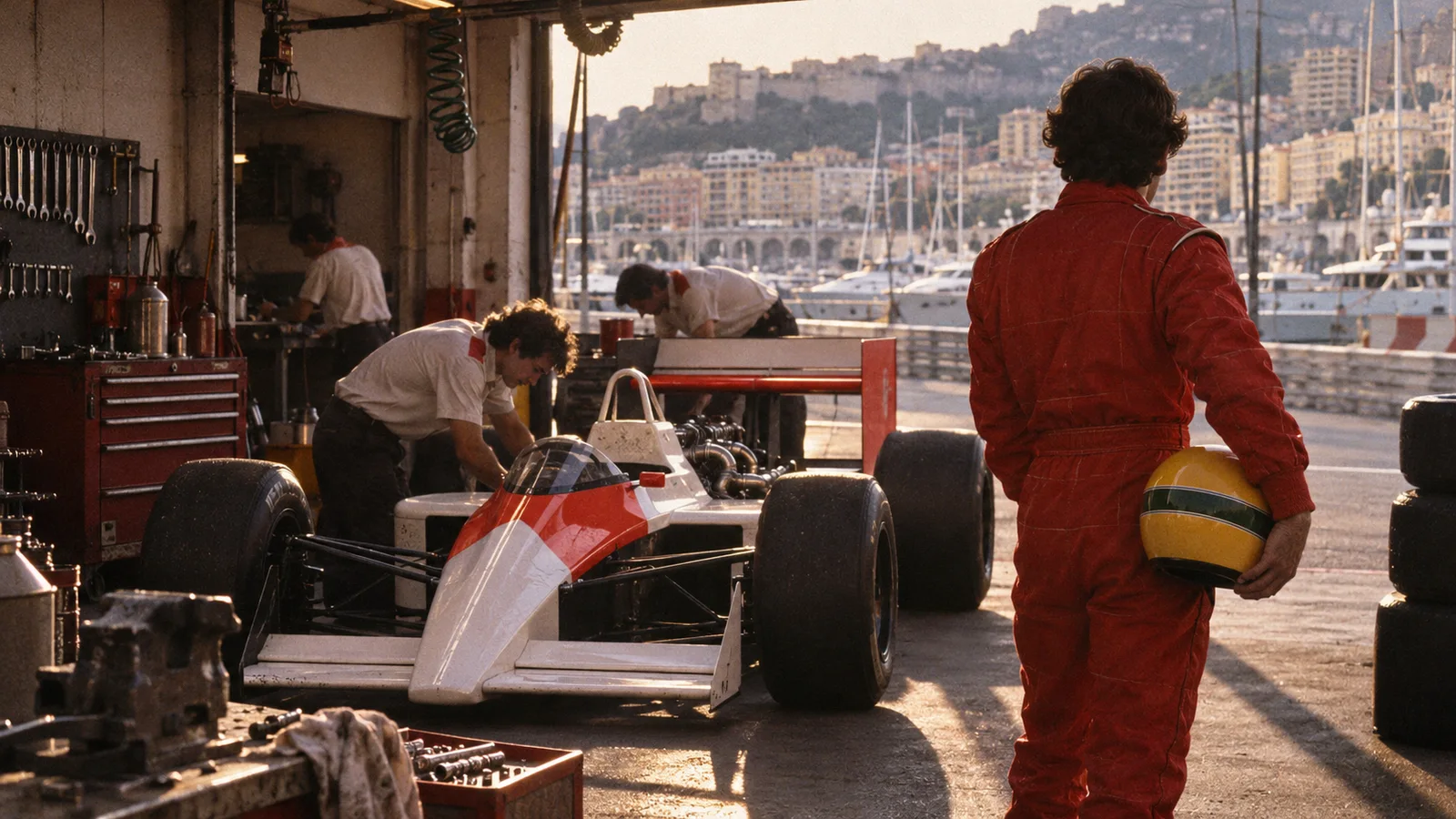
When Williams moved ahead, Senna’s challenge changed. The final McLaren years brought frustration, unforgettable opportunism, and a farewell nobody yet knew was a farewell.
In this chapter 6 sections ↓
The champion and the faster car
Nigel Mansell’s Williams became the defining car of 1992. McLaren could still win, but it no longer controlled the terms of the championship as it had in its strongest seasons. Ron Dennis remembered Senna’s difficulty with that loss of competitiveness. Their shared history of winning had to make room for a period in which effort did not guarantee the same rewards.
At Monaco, a late problem sent Mansell to the pits and put Senna ahead. The Williams returned with fresh tyres and closed on the McLaren. Senna kept the narrow streets between his rival and a passing opportunity, winning by 0.215 seconds. This was not superiority over a whole afternoon; it was the disciplined use of the opportunity the race finally offered.
A different engine, a renewed uncertainty
Honda left Formula One after 1992. For 1993, McLaren used Ford V8 power in the MP4/8. Prost returned to racing with Williams, taking the seat in the team Senna also wanted. Contemporary reporting recorded Senna’s anger about the contractual situation. His own earlier influence over the second Lotus seat made the dispute more complicated than a simple story of being denied fairness.
The problem he faced was practical as well as personal. Championship ambition had to be pursued in a package that was not the technical benchmark. He would have to build a season from particular chances, rather than assume the car could make every race a direct fight with the Williams.
Brazil: a second home victory
Changing weather at Interlagos created one of those chances. Senna won the 1993 Brazilian Grand Prix, the second and final home victory of his career. McLaren’s history identifies it as the team’s hundredth Formula One win, a milestone reached through the judgement required by a race that would not remain in one condition.
The scene was familiar in its colours but different in its competitive meaning. Two years earlier he had brought a failing championship-leading car home. Now he had used an unsettled race to beat a stronger overall opposition. The Brazilian audience was seeing another version of the same driver: commitment expressed through adaptation.
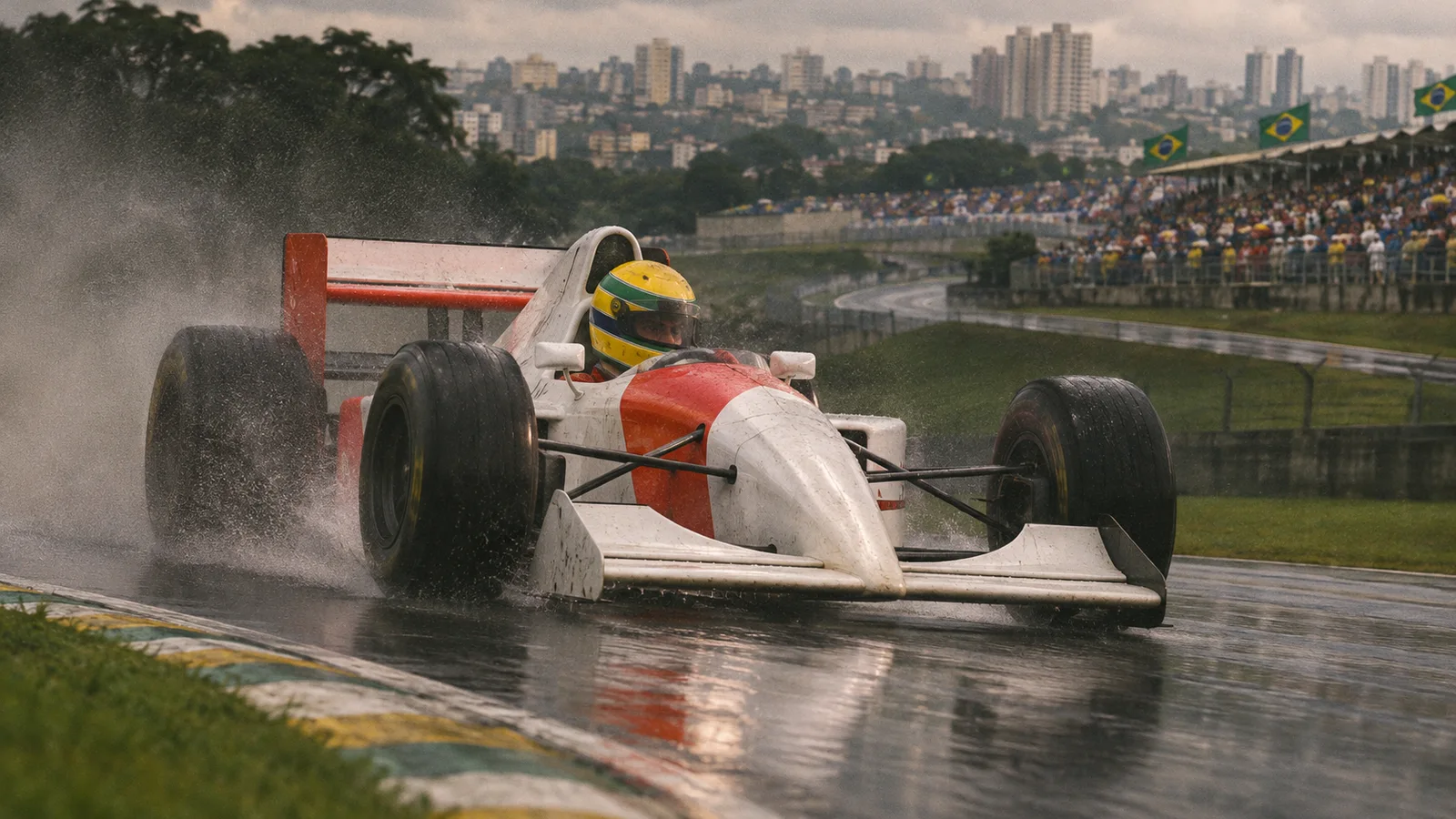
An interpretation of the 1993 McLaren and Interlagos environment. Not an exact race moment or racing line.
Donington: the opening lap is only the beginning
At Donington Park on 11 April, Senna started fourth, briefly fell to fifth and ended the first lap in the lead. The sequence made his response to wet grip visible at an extraordinary pace. Schumacher, Wendlinger, Hill and Prost were all passed before the field reached the line again.
The rest of the race required repeated decisions about tyres and weather. McLaren’s pit-stop history records four completed stops for Senna, against six for Hill and seven for Prost. He won decisively. The opening lap is rightly celebrated, but the victory was also a long exercise in judging when not to do what the other leading cars were doing.
FOLLOW THIS STORYFollow the opening lap and the decisions after itThe sixth Monaco, and the temper that remained
A sixth Monaco win followed in 1993. The record made the circuit look almost like a personal territory, even though every one of those victories had depended on a different combination of machinery, circumstances and judgement. There was still room for Senna to make a circuit his own when he could not make a championship his own.
The season also included the post-race confrontation with Eddie Irvine at Suzuka. Angry that the rookie had unlapped himself, Senna went to the Jordan area and struck him. The event was captured on a recording and later recounted by witnesses. It was a failure of restraint after a victory, not an act that becomes admirable because the champion had been irritated.
Adelaide, 7 November
Senna won the final race of the season in Adelaide, with Prost second and Damon Hill third. It was his fifth victory of 1993 and the forty-first of his Formula One career. Prost was retiring; Senna was leaving McLaren for Williams. The podium joined an ending everyone recognised to an ending nobody could yet recognise.
The public thaw between the rivals became one of its enduring images. Prost would later describe more frequent conversations after retirement had removed the need to fight for the same result. Six seasons at McLaren were over. Senna was thirty-three, with a new team waiting and the pursuit of a fourth championship still ahead of him.
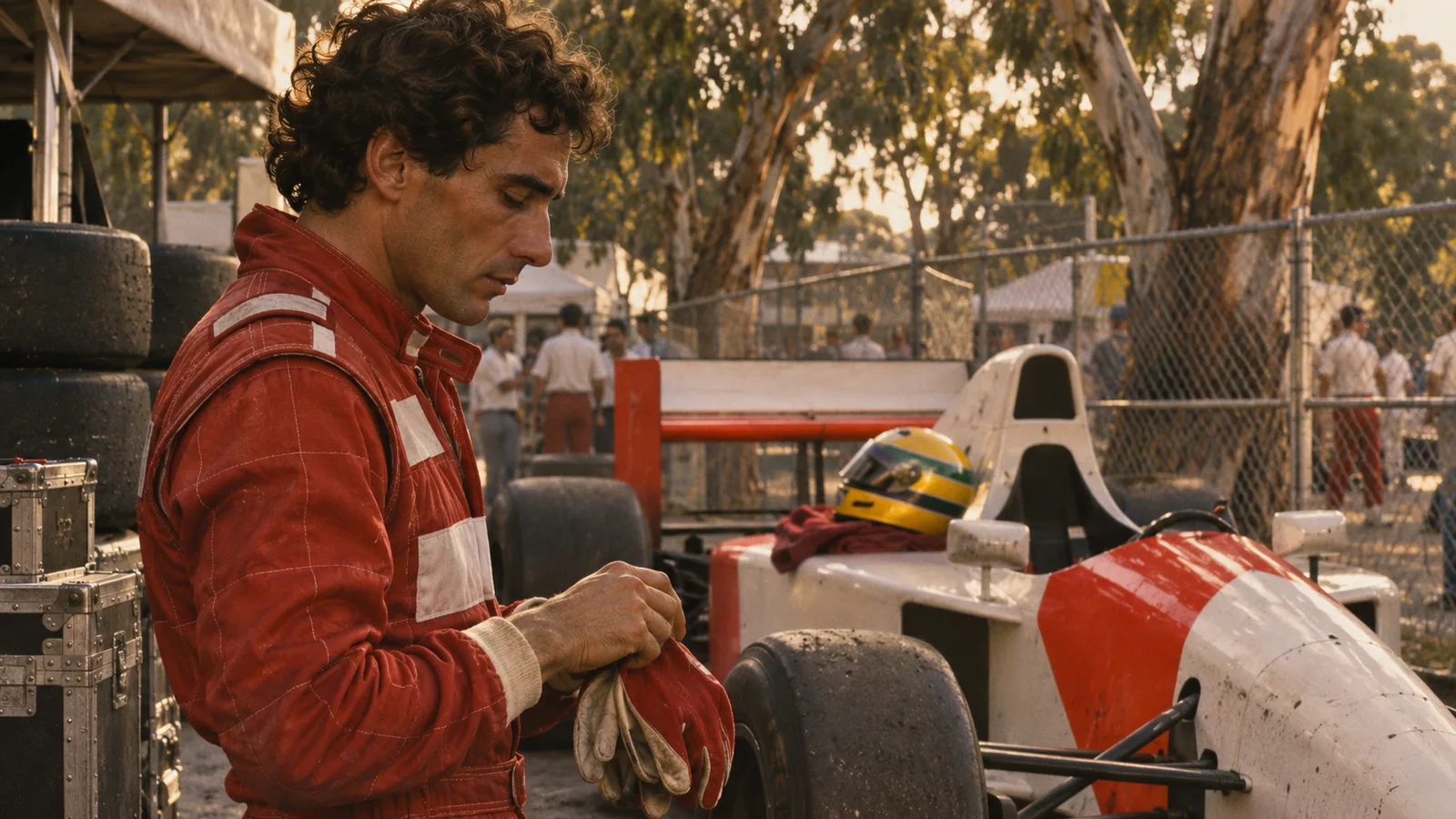
An imagined Adelaide paddock moment in 1993. The depicted gesture is not a documented action.
THE RECORD BEHIND THE STORY
Sources & perspective
References are connected to the passages above. Recollections retain the perspective of their speakers; technical explanations and editorial interpretation do not imply access to private thoughts. All scene imagery is AI-generated.
01 · Formula 1 · 29 April 2014Ron Dennis on Senna — the later years ↗Attributed testimony on Berger, competitiveness and life inside McLaren.02 · Formula 1In numbers: the Monaco Grand Prix ↗The 0.215-second 1992 winning margin over Nigel Mansell.03 · McLaren · team archiveSenna’s moments of Monaco magic ↗His six Monaco wins and the loss in 1988. A former employer’s perspective.04 · Motor Sport · November 1992Contractual chess ↗Contemporary reporting on the 1993 Williams seats and Senna’s frustration.05 · McLaren · heritageAyrton Senna ↗Six McLaren seasons, championships and the Ford-powered MP4/8.06 · McLaren · 2026 race previewSão Paulo preview: the 1993 Brazilian Grand Prix remembered ↗Historical passage on changing weather, the safety car and McLaren’s 100th F1 win.07 · McLaren · 11 April 2024McLaren Trophies: European GP, 1993 ↗Opening lap and victory at Donington Park.08 · McLaren · team historyTwelve race-changing pit stops ↗The 1993 European GP section covers four completed Senna stops and the fastest lap through the pit lane.09 · Formula 1 · On the Edge · 30 June 2021When Senna punched Irvine: eyewitness accounts ↗Accounts supported by Adam Cooper’s recording of the 1993 confrontation; the article identifies the participating witnesses.10 · Formula 1 · official results1993 Australian Grand Prix: race result ↗7 November 1993: Senna, Prost and Hill on the podium.11 · Formula 1 · 2 May 2014Vital statistics: Ayrton Senna ↗Historical totals. Any all-time rankings in this 2014 article are dated and are not repeated as current rankings.12 · Beyond the Grid · Formula 1 · 26 September 2018Prost on his career and his relationship with Senna ↗Prost describes supporting Senna’s arrival and their conversations after his retirement. An attributed perspective.Full bibliography & image disclosure ↗