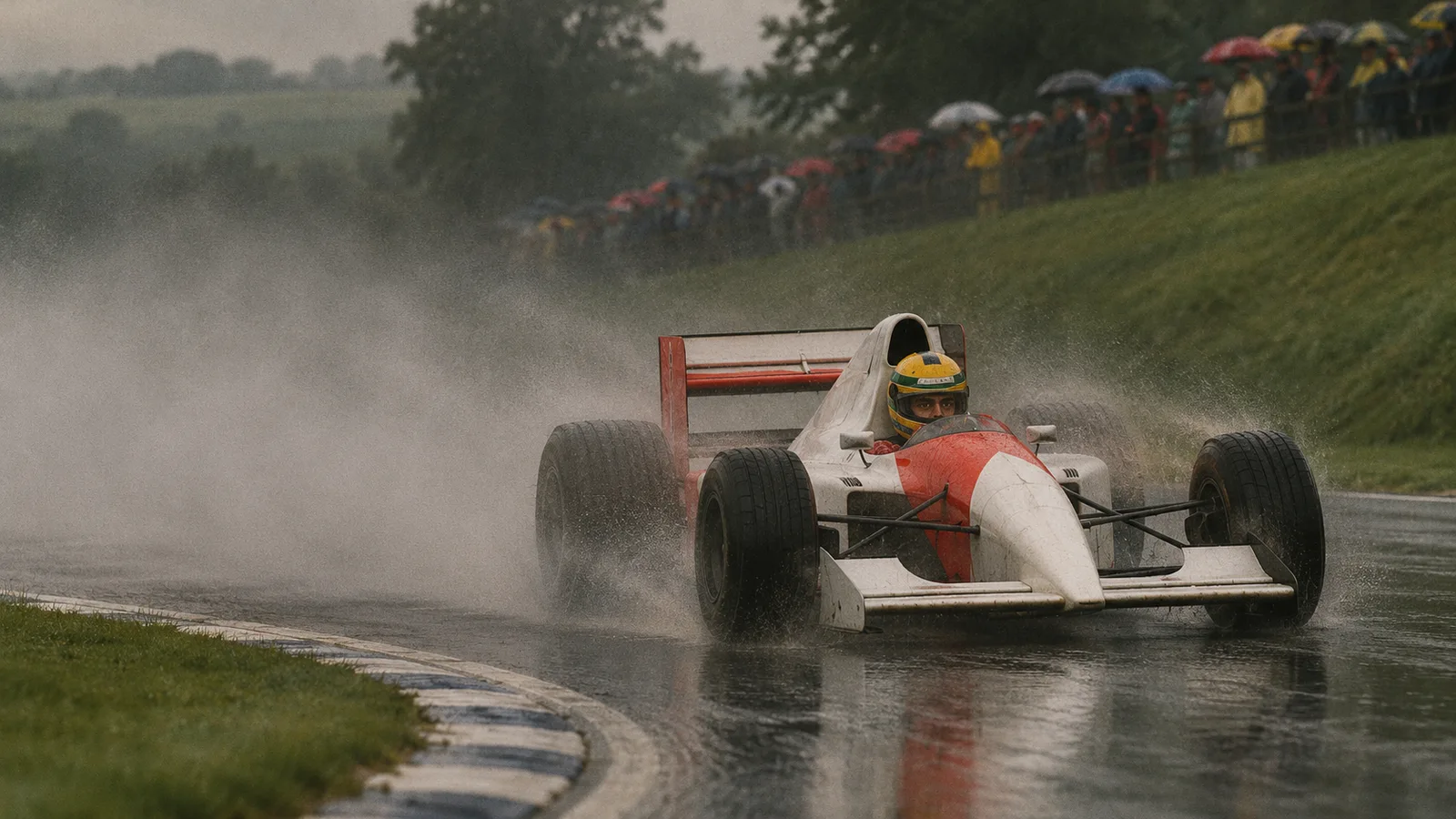
One lap made the race famous. The seventy-five laps after it explain why the first lap became a victory rather than a brilliant beginning that the afternoon took away.
In this story 6 sections ↓
A fourth-place start becomes fifth
The 1993 European Grand Prix began on a damp Donington Park circuit. Prost and Hill’s Williams cars were ahead, as was Schumacher’s Benetton. Senna qualified fourth in the Ford-powered McLaren and briefly fell to fifth as the opening corner compressed the field.
In a dry race, relative car performance might have established a more durable order. The wet surface made the first corners a succession of immediate questions about grip. Senna’s answer was visible in the speed with which he moved back past the cars around him. The lap would be remembered because it joined several decisions before anyone else could make the first setback seem important.
Down the Craner Curves
Schumacher was passed, then Wendlinger. The move around the Sauber through the Craner Curves became the lap’s signature image: a quick change of direction on a falling piece of road, with the available grip difficult to judge from outside the car.
It is tempting to call such a move pure courage. But courage without an estimate of what the tyres can do ends very quickly. What the sequence shows is commitment attached to a judgement, then another judgement made from the position the first one has created. A driver cannot pause the lap to consider how remarkable the last pass looked.
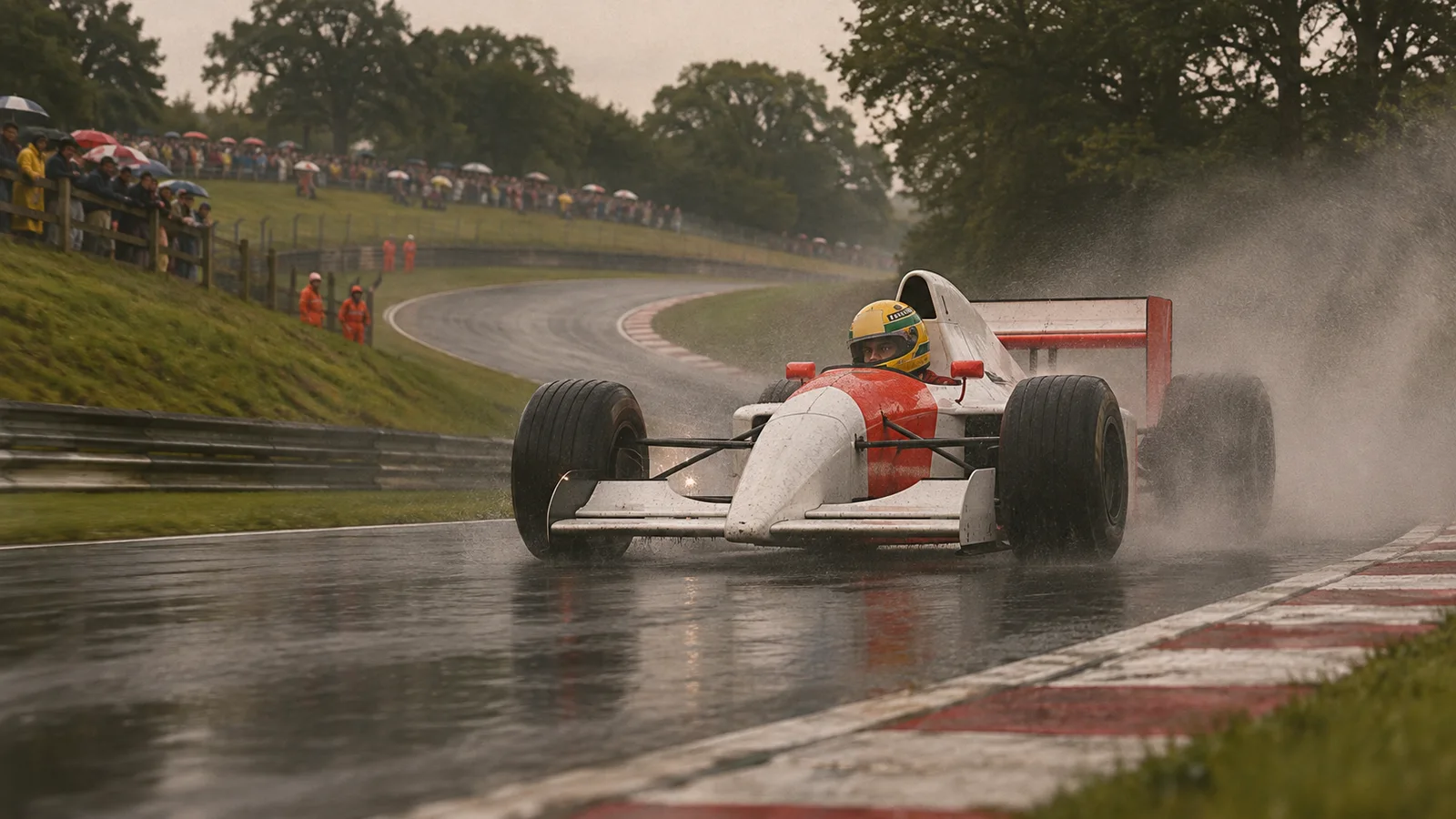
An interpretation of the 1993 car and circuit environment, not a record of the opening-lap pass.
Two Williams cars before the line
Hill was the next target. Senna then closed on Prost and took the lead at the Melbourne Hairpin before the opening lap was over. Fifth had become first through four passes. The sequence was not a single dramatic lunge that happened to work, but a continuous rearrangement of the race.
The Williams remained the stronger championship package. Rain had not made engineering irrelevant, and the McLaren’s own systems still mattered. What changed was the opportunity for a driver to use the grip he could find and the space other drivers left. Senna had converted that opportunity into control of the race almost immediately.
The decision in the pits, and the decision to stay out
Conditions continued to change. Wet tyres could offer security in rain and then lose performance as the surface dried; dry tyres could become the wrong choice when another shower arrived. Each stop exchanged time in the pit lane for a prediction about what the next laps would require.
McLaren records four completed stops for Senna, six for Hill and seven for Prost. These figures are not a complete model of the strategy, but they show why the first lap cannot stand for the whole result. Senna and his team were also winning time through choices about when to change tyres and when to accept the discomfort of staying out.
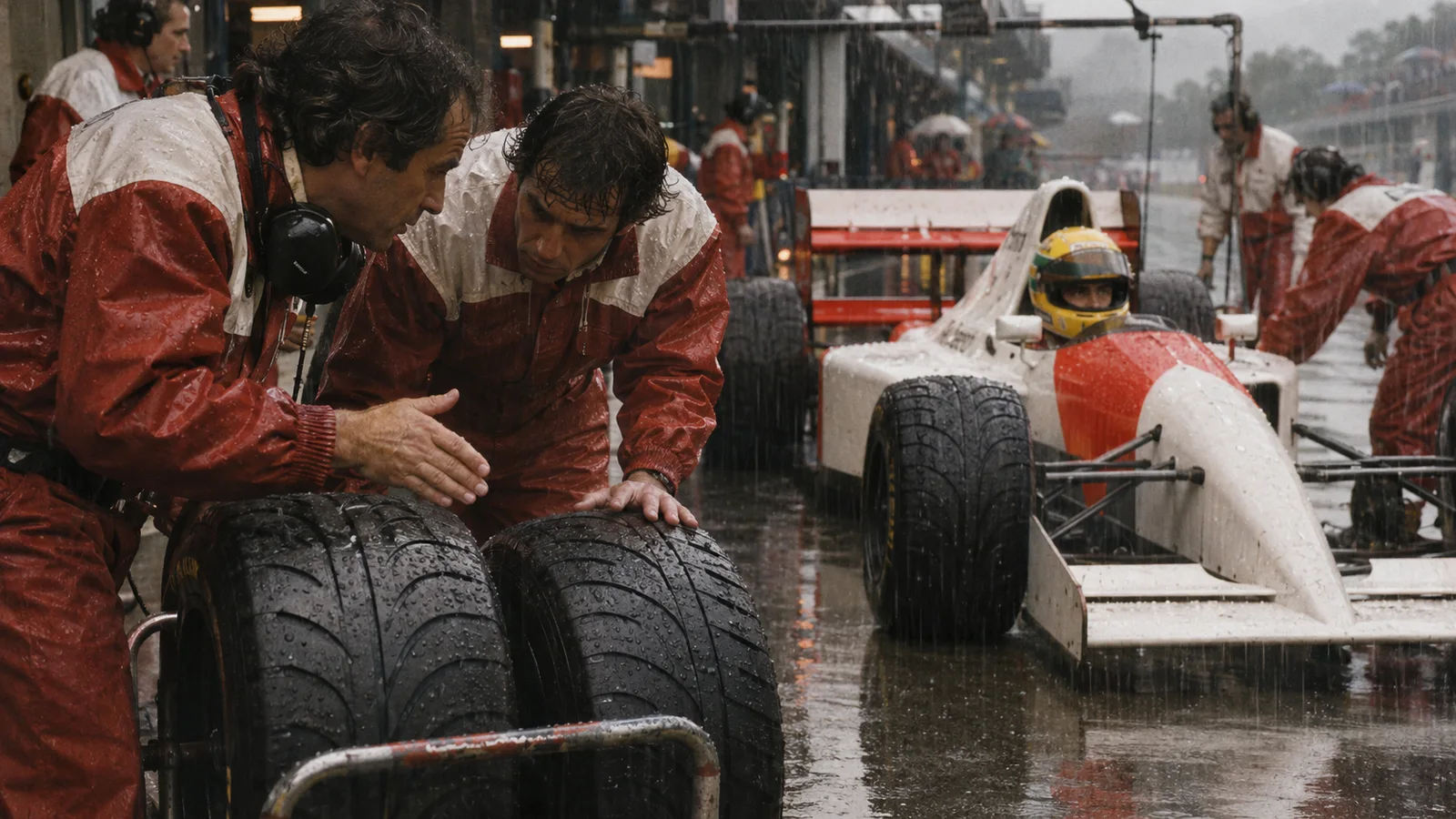
An imagined 1993 pit-lane working scene. It does not establish the sequence or timing of an actual stop.
The strange fastest lap
His fastest lap came with an unusual detour. Senna entered the pit lane, did not make a service stop, and continued. At that event there was no pit-lane speed limit, and the route effectively offered a shortcut. Formula One’s records feature identifies this as part of the explanation for the lap.
The detail is useful because it keeps admiration attached to the actual event. The fastest time was not simply another proof that he was intrinsically much quicker on every section of the track. It arose from an extraordinary drive and an unusual configuration of rules and road. History becomes more interesting when the inconvenient detail is allowed to stay.
Seventy-six laps completed
The official result records Senna winning after seventy-six laps, 83.199 seconds ahead of Hill. Prost finished a lap down. The margin established that the opening sequence had grown into control over the full distance, despite the repeated opportunities for the changing weather to reverse it.
Donington belongs to the final McLaren year, when Senna could no longer expect the best overall machinery. It demonstrates something more specific than the claim that he could transcend any car: on this day, in this car, he and the team found opportunities that the opposition did not use as effectively. That is a large enough achievement without making it supernatural.
THE RECORD BEHIND THE STORY
Sources & perspective
References are connected to the passages above. Recollections retain the perspective of their speakers; technical explanations and editorial interpretation do not imply access to private thoughts. All scene imagery is AI-generated.
01 · McLaren · racing archiveNine wet races: Donington 1993 ↗The overtaking sequence, changing conditions and tyre decisions.02 · McLaren · 11 April 2024McLaren Trophies: European GP, 1993 ↗Opening lap and victory at Donington Park.03 · McLaren · heritageAyrton Senna ↗Six McLaren seasons, championships and the Ford-powered MP4/8.04 · McLaren · team historyTwelve race-changing pit stops ↗The 1993 European GP section covers four completed Senna stops and the fastest lap through the pit lane.05 · Formula 1 · historical records featureSenna’s unusual Donington fastest lap ↗The pit-lane shortcut and absence of a pit-lane speed limit at that event. Dated records elsewhere in the feature are not treated as current.06 · Formula 1 · official results1993 European Grand Prix: race result ↗76 laps, the 83.199-second winning margin and the final classification.Full bibliography & image disclosure ↗