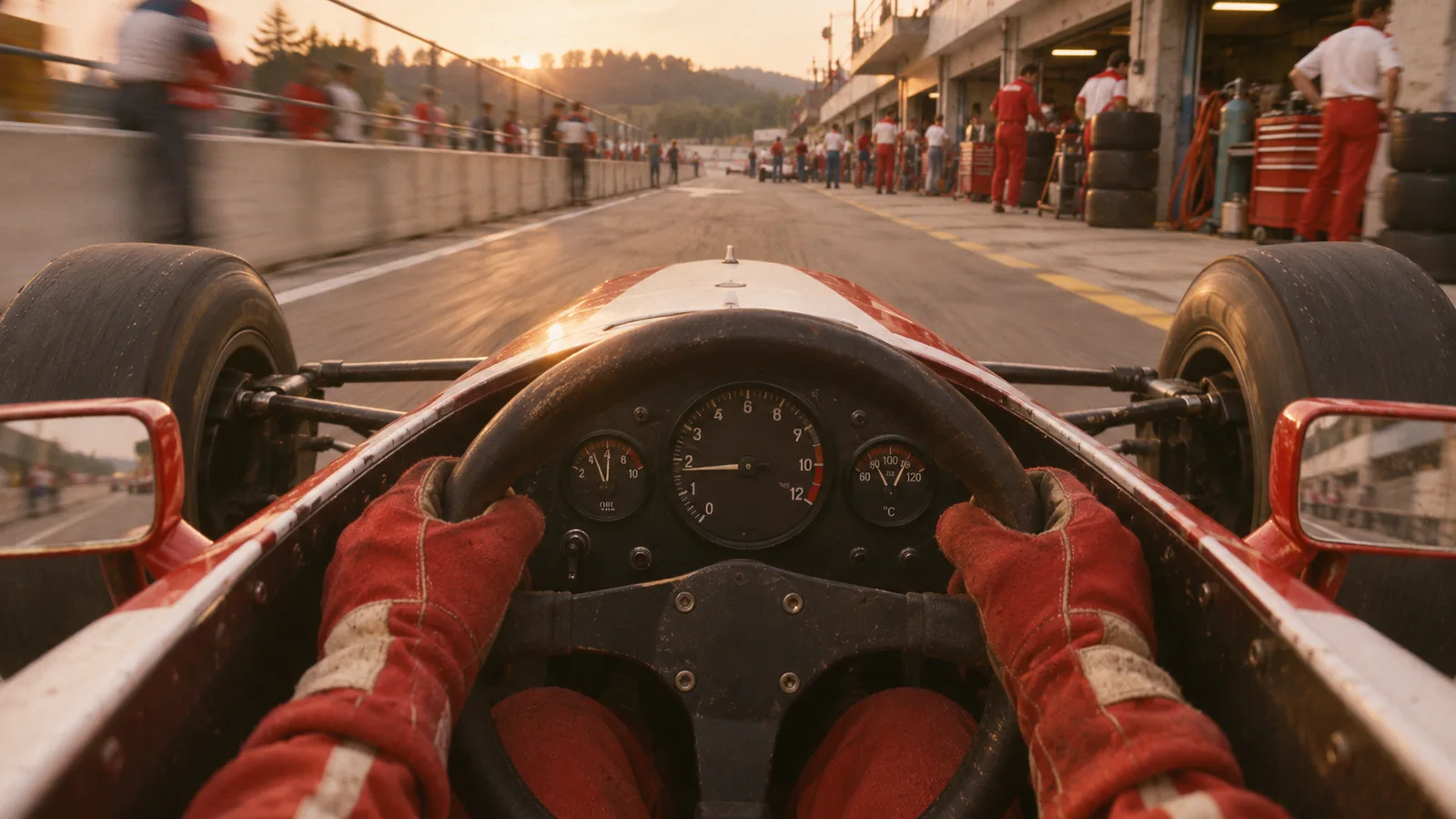
A failing gearbox made Senna’s first Brazilian Grand Prix victory an exercise in preserving a possibility. The car was still moving. He had to find a way to keep it moving long enough.
In this story 6 sections ↓
The win that had not come
Senna’s first Brazilian Grand Prix was in 1984 at Jacarepaguá in Rio. By 1991, the race had returned to Interlagos in São Paulo and he was already a double world champion, but the home victory was still missing. The place connected his professional world to the region where he had begun driving a kart.
That history made the race significant before anything failed. It was an opportunity to finish a sporting task in front of the audience most closely associated with his public identity. The challenge would not come only from the other cars. The machinery beneath him would become part of the opposition.
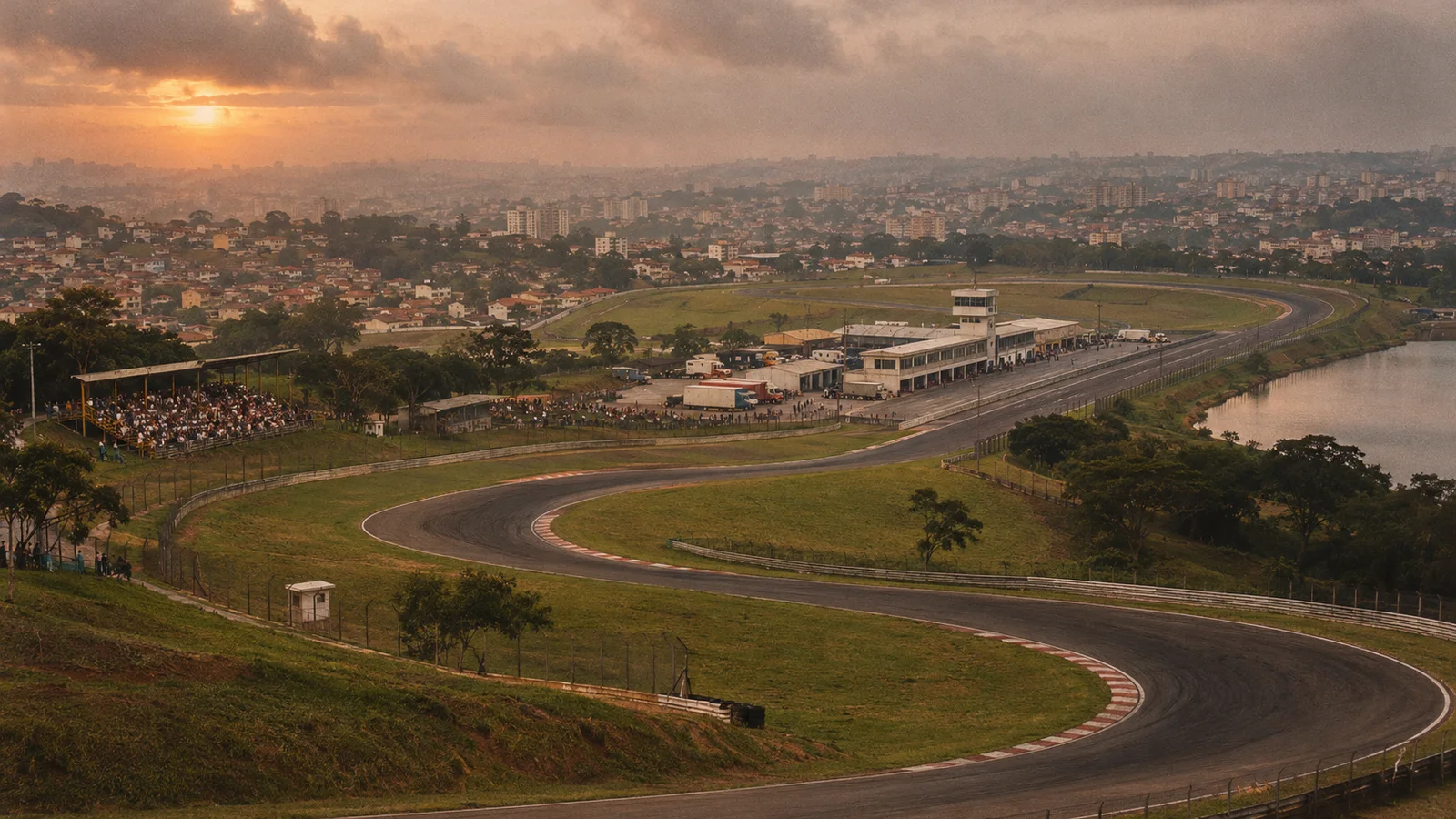
An imagined 1991-era aerial view. Circuit and skyline geometry are illustrative.
The early advantage
The McLaren MP4/6 was new, with Honda’s V12 replacing the earlier V10. The engine and chassis were still being developed around a changing balance of power, weight and fuel consumption. Senna’s strong start to the season did not mean that the package had become a simple or finished object.
At Interlagos he put himself in position to win. The achievement was then threatened by the transmission. Gearbox trouble is especially disruptive because the driver cannot solve it merely by accepting a little less power. The connection between engine speed, road speed and the demands of each corner is being altered underneath the familiar sequence of the lap.
Why the familiar shorthand needs a closer look
The story is usually told as a car stuck in sixth gear. McLaren’s account describes the gearbox jumping out of gear and Senna choosing to remain in sixth because it was the reliable option. That changes the emphasis from passive misfortune to an active decision about how to finish.
He was not selecting an ideal gear for every corner. He was selecting a workable condition for the car as a whole. A racing driver is normally trying to place the engine in a useful range repeatedly through a lap. Here, maintaining one dependable relationship between engine and wheels became more important than achieving the best relationship at each moment.
Getting out of a slow corner in a high gear
A high gear suits speed on a straight. At low road speed it provides less torque multiplication at the wheels, so accelerating away becomes difficult. Too much lost momentum can leave the engine struggling, while too much entry speed can send the car wide before the driver has a chance to use that momentum at all.
The problem therefore reaches back into the approach to a corner. The driver must preserve enough speed to keep the exit viable while still making the turn. It is a compromise made repeatedly, under physical strain, with a rival able to gain time while the damaged car negotiates its new limitations.
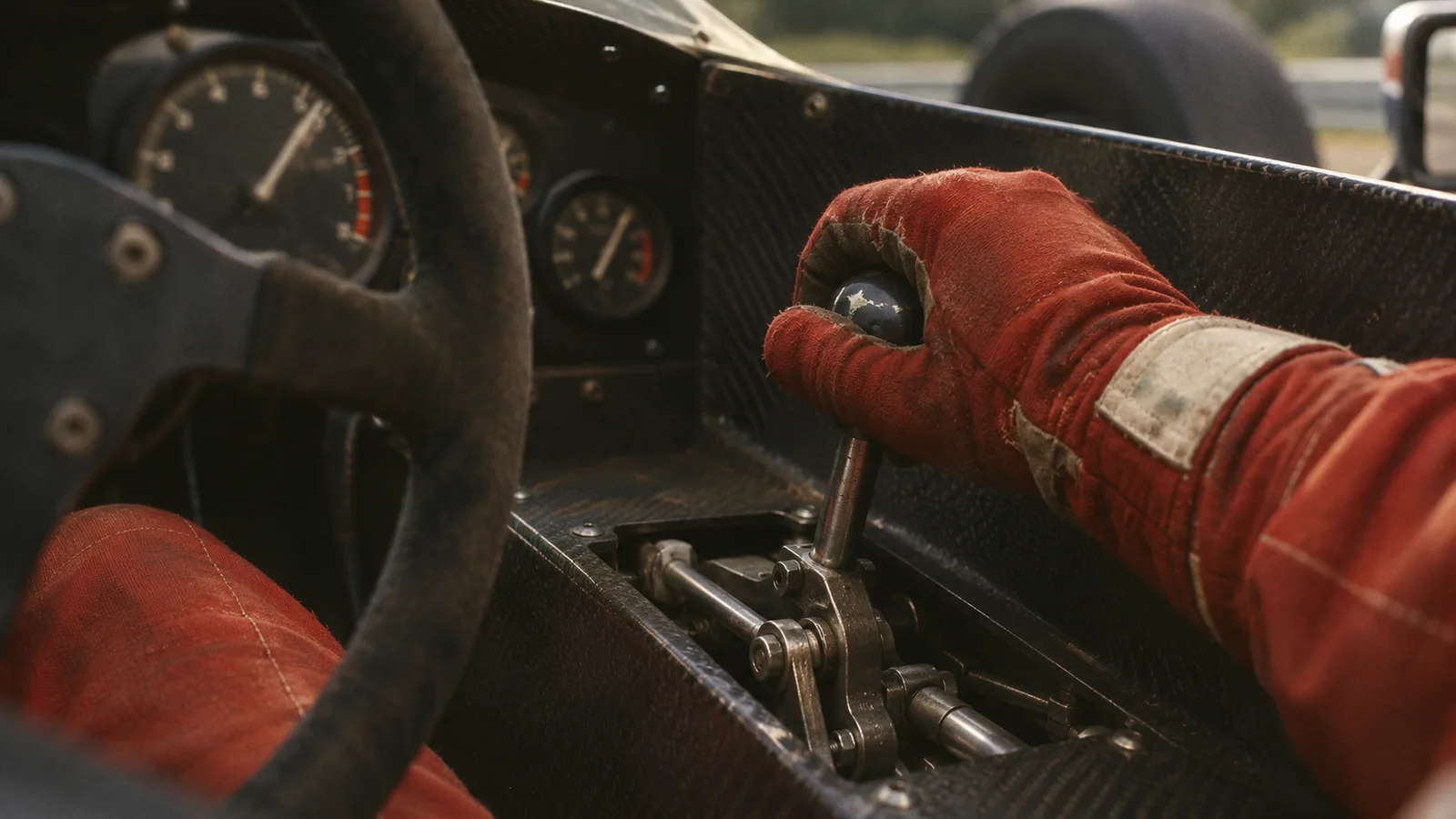
A generic period manual-gearbox cockpit detail. Not Senna’s recorded hand position, telemetry or an exact failure reconstruction.
The gap at the line
Riccardo Patrese finished 2.991 seconds behind. The official classification records seventy-one laps for both cars. Gerhard Berger completed the podium. The result makes the outcome look compact: a name in first place, another in second, a time between them.
The visible exhaustion afterwards gives those figures another dimension. A result that had once depended on the strength of the package had come to depend on keeping a damaged version of it usable. The wait for the home victory ended through management and endurance, rather than a clean exhibition of maximum performance.
What the victory carried
The importance of Interlagos is not that Senna became something other than human for the final laps. It is that the difficulty remained humanly legible: uncertainty about the car, the effort of operating it, and the possibility that the result could still disappear before the finish.
He had won in Brazil at last. The championship season continued, but the home race had acquired an independent place in his story. To follow it closely is to see that the most powerful sporting moments are not always the ones in which talent makes the task look easy.
THE RECORD BEHIND THE STORY
Sources & perspective
References are connected to the passages above. Recollections retain the perspective of their speakers; technical explanations and editorial interpretation do not imply access to private thoughts. All scene imagery is AI-generated.
01 · McLarenLegendary Laps: Brazil ’91 ↗Explains the gearbox’s tendency to jump out of gear and his choice to remain in sixth.02 · Formula 1 · official results1991 Brazilian Grand Prix: race result ↗71 laps and the final 2.991-second margin over Patrese.03 · McLaren · car archiveMcLaren MP4/6 ↗V12 development, four opening wins, fuel difficulties and the Williams challenge. Participant history.Full bibliography & image disclosure ↗